
- DOT Label: Flammable Liquid
- First Aid: Swallow: Medical attention immediately - If this chemical has been swallowed, get medical attention immediately.
- Fire Hazards: Flammable. Gives off irritating or toxic fumes (or gases) in a fire. Above 32 °C explosive vapour/air mixtures may be formed.
- Safe Storage: Fireproof. Separated from strong oxidants.
- Fire Fighting: Use water spray, alcohol-resistant foam. In case of fire: keep drums, etc., cool by spraying with water.
- Target Organs: Eyes, respiratory system
- Toxicity Data: LCLo (rat) = 2,000 ppm/4H
- Eye Prevention: Wear safety goggles or eye protection in combination with breathing protection.
- Fire Potential: ...A DANGEROUS FIRE HAZARD...
- Health Hazards: Exposure can cause irritation of eyes, nose and throat. Contact with eyes may result in foggy vision and seeing halos around lights. (USCG, 1999)
- Reactive Group: Ethers
- Cleanup Methods: Cover with the 9:1 mixture of sand and soda ash. After mixing, transfer into a paper carton, stuffed with ruffled paper. Burn in an open furnace with the utmost care or in the furnace with afterburner and scrubber.
- Exposure Routes: inhalation, skin absorption, ingestion, skin and/or eye contact
- Fire Prevention: NO open flames, NO sparks and NO smoking. NO contact with hot surfaces. Above 32 °C use a closed system, ventilation and explosion-proof electrical equipment.
- Hazards Summary: Has potential to cause corneal damage; [ACGIH]
- Inhalation Risk: A harmful contamination of the air can be reached rather quickly on evaporation of this substance at 20 °C.
- Skin Prevention: Protective gloves. Protective clothing.
- Disposal Methods: LARGE QUANTITIES CAN BE COLLECTED & ATOMIZED IN A SUITABLE COMBUSTION CHAMBER EQUIPPED WITH AN APPROPRIATE EFFLUENT GAS CLEANING DEVICE.
- Flammable Limits: Flammability: Class IC Flammable Liquid: Fl.P. at or above 73 °F and below 100 °F.
- Reactivity Alerts: Highly Flammable
- Spillage Disposal: Personal protection: filter respirator for organic gases and vapours adapted to the airborne concentration of the substance. Ventilation. Remove all ignition sources. Collect leaking and spilled liquid in sealable containers as far as possible. Absorb remaining liquid in sand or inert absorbent. Then store and dispose of according to local regulations.
- UN Classification: UN Hazard Class: 3; UN Pack Group: III
- Environmental Fate: ATMOSPHERIC FATE: Based on an experimental vapor pressure of approximately 5 mm Hg at 25 °C(1), and a suggested classification scheme(2), N-ethylmorpholine will exist primarily in the vapor phase in the atmosphere(SRC). It will degrade in the ambient atmosphere by reaction with photochemically produced hydroxyl radicals with an estimated half-life of 2.5 hours(3,SRC). Removal of atmospheric N-ethylmorpholine may occur through wet deposition(SRC).
- First Aid Measures: Ingestion First Aid: Rinse mouth. Give one or two glasses of water to drink.
- Reactivity Profile: N-ETHYL MORPHOLINE can react vigorously with oxidizing materials. It dissolves LiAlH4. (NTP, 1992)
- Signs and Symptoms: irritation eyes, nose, throat; visual disturbance: corneal edema, blue-gray vision, colored haloes
- Storage Conditions: Store in a detached storehouse without any ignition source.
- Preventive Measures: Take off the clothing followed by drying and washing or disposing. Dispose shoes by incineration.
- Ingestion Prevention: Do not eat, drink, or smoke during work.
- Inhalation Prevention: Use ventilation, local exhaust or breathing protection.
- Nonfire Spill Response: LARGE SPILL: Dike far ahead of liquid spill for later disposal. Water spray may reduce vapor, but may not prevent ignition in closed spaces. (ERG, 2024)
- Air and Water Reactions: Highly flammable. Moderately soluble in water.
- Human Toxicity Excerpts: ... An epidemic of neurogenic urinary retention from a company, employing 141 and 75 people at 2 different plants, manufacturing polyurethane foam products ... Abnormalities in vision, upper respiratory irritation, dermatitis, and pulmonary abnormalities also occurred but appeared to be related to the presence of other chemicals including N-ethylmorpholine and toluene diisocyanate.
- Isolation and Evacuation: FIRE: If tank, rail tank car or highway tank is involved in a fire, ISOLATE for 800 meters (1/2 mile) in all directions; also, consider initial evacuation for 800 meters (1/2 mile) in all directions. (ERG, 2024)
- Soil Adsorption/Mobility: Using a structure estimation method based on molecular connectivity indexes(1), the Koc for N-ethylmorpholine can be estimated to be about 12(SRC). According to a suggested classification scheme(2), this estimated Koc value suggests that N-ethylmorpholine has very high soil mobility(SRC).
- Non-Human Toxicity Values: The oral, single-dose LD50 for rats was 1.78 g/kg (1.49-2.12 g/kg) ...
- NFPA Hazard Classification: NFPA Instability Rating: 0 - Materials that in themselves are normally stable, even under fire conditions.
- Respirator Recommendations: Important additional information about respirator selection
- Lower Explosive Limit (LEL): 1 % (USCG, 1999)
- Non-Human Toxicity Excerpts: ... 1 of 6 rats died after a 4-hr inhalation exposure at 2000 ppm.
- Upper Explosive Limit (UEL): 9.8 % (USCG, 1999)
- Artificial Pollution Sources: N-Ethylmorpholine's use as an intermediate for dyestuffs, pharmaceuticals, rubber accelerators, and emulsifying agents(1) may result in its release to the environment through various waste streams(SRC).
- Threshold Limit Values (TLV): 5 ppm as TWA; (skin)
- Hazard Classes and Categories: Flammable agents - 3rd degree
- Effects of Short Term Exposure: The substance is irritating to the eyes, skin and respiratory tract. The substance may cause effects on the eyes. This may result in distortion of vision.
- Environmental Bioconcentration: Because it is miscible in water(2), bioconcentration in aquatic organisms is not expected to be an important fate process for N-ethylmorpholine(1,SRC).
- Explosive Limits and Potential: Explosive limits, vol% in air: 1-9.8
- Volatilization from Water/Soil: The Henry's Law constant for N-ethylmorpholine can be estimated to be 2.47X10⁻⁸ atm-cu m/mole(SRC) using a structure estimation method(1). This value of Henry's Law constant indicates that N-ethylmorpholine will be essentially non-volatile from water(2).
- Permissible Exposure Limit (PEL): TWA 20 ppm (94 mg/m3) [skin] See Appendix G
- Recommended Exposure Limit (REL): TWA 5 ppm (23 mg/m3) [skin]
- Environmental Abiotic Degradation: The rate constant for the vapor-phase reaction of N-ethylmorpholine with photochemically produced hydroxyl radicals has been estimated to be approximately 1.49X10⁻¹⁰ cu cm/molecule-sec at 25 °C which corresponds to an atmospheric half-life of about 2.5 hours at an atmospheric concentration of 5x10+5 hydroxyl radicals per cu cm(1,SRC).
- Probable Routes of Human Exposure: Occupational exposure to morpholines, such as N-ethylmorpholine, can occur through inhalation, dermal contact and ingestion(1).
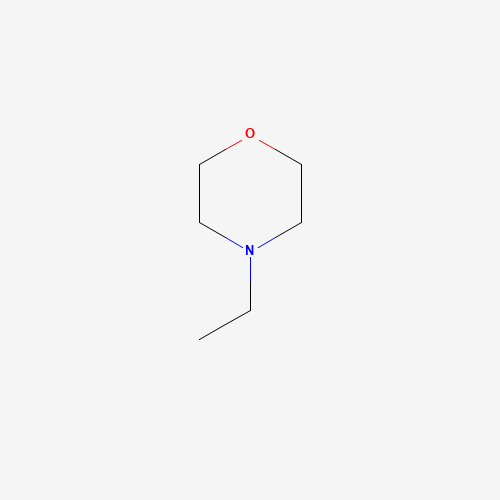
- Environmental Fate/Exposure Summary: N-Ethylmorpholine's use as an intermediate for dyestuffs, pharmaceuticals, rubber accelerators, and emulsifying agents may result in its release to the environment through various waste streams. If released to water, N-ethylmorpholine will be essentially non-volatile. Insufficient data are available to predict the relative importance or rate of biodegradation in soil or water. If released to the atmosphere, N-ethylmorpholine will exist primarily in the vapor phase. Vapor-phase N-ethylmorpholine will degrade in the atmosphere by reaction with photochemically produced hydroxyl radicals with an estimated half-life of approximately 2.5 hours. Removal of atmospheric N-ethylmorpholine may occur through wet deposition. If released to soil, N-ethylmorpholine is expected to have very high mobili...
- Skin, Eye, and Respiratory Irritations: ... Ten humans exposed at 100 ppm N-ethylmorpholine for 2.5 min experienced irritation to the eyes, nose, and throat and olfactory fatigue. Irritation was slight with the same duration of exposure at 50 ppm and absent at 25 ppm.
- Immediately Dangerous to Life or Health (IDLH): See: 100743
Warm reminder:
Because the manufacturer may temporarily adjust product specifications, prices, inventory, parameters and other information without notice, and there are differences in each user's consultation time and procurement needs, the platform reply content is only of reference value within a certain period. Sorry for the inconvenience caused to you, and thank you for your understanding and support! Please consult the online customer service for the latest details. Everything is subject to the real-time reply of the customer service.!
Please check the quantity, appearance and product information in time when you receive the goods. In case of damage, wrong delivery, abnormal quality and other problems, please feel free to contact us.
Service Hotline:400-6226-992 ,We will handle it for you as soon as possible, thank you for your support and trust.!
Research chemical 99%; 10L
Research chemical 99%; 10L; supplied for laboratory research, analysis, inspection, and scientific procurement use; specifications: 99%; 10L.