
- DOT Label: Corrosive Poison
- First Aid: OTHER: Since this chemical is a known or suspected carcinogen you should contact a physician for advice regarding the possible long term health effects and potential recommendation for medical monitoring. Recommendations from the physician will depend upon the specific compound, its chemical, physical and toxicity properties, the exposure level, length of exposure, and the route of exposure. (NTP, 1992)
- Fire Hazards: Non-combustible, substance itself does not burn but may decompose upon heating to produce corrosive and/or toxic fumes. Some are oxidizers and may ignite combustibles (wood, paper, oil, clothing, etc.). Corrosives in contact with metals may evolve flammable hydrogen gas. Containers may explode when heated. For electric vehicles or equipment, ERG Guide 147 (lithium ion or sodium ion batteries) or ERG Guide 138 (sodium batteries) should also be consulted. (ERG, 2024)
- Interactions: Hydrazine sulfate potentiated the antitumor action of cyclophosphamide, mitomycin c, methotrexate, and bleomycin against Walker 256 intramuscular carcinosarcoma in rats.
- Fire Fighting: This compound is not very flammable but any fire involving this compound may produce dangerous vapors. You should evacuate the area. All firefighters should wear full-body protective clothing and use self-contained breathing apparatuses. You should extinguish any fires involving this chemical with a dry chemical, carbon dioxide, foam, or halon extinguisher. (NTP, 1992)
- Health Hazards: ACUTE/CHRONIC HAZARDS: Toxic. May cause irritation on contact. Hazardous decomposition products. OSHA category I carcinogen. Mutagen. (NTP, 1992)
- Reactive Group: Salts, Acidic
- Adverse Effects: NTP Carcinogen - Reasonably anticipated to be a human carcinogen.
- Hazards Summary: Emergency treatment: Hydrazines; Hydrazines can cause severe eye damage. They can cause seizures, liver injury, hemolysis, and delayed pulmonary edema. A strong reducing agent; May cause irritation; [CAMEO] An irritant; May cause skin sensitization; May be fatal by inhalation; [MSDSonline] See Hydrazine.
- Special Reports: Toth B; Teratogenic hydrazines: a review; In Vivo Jan-Feb 7 (1): 101-10 (1993). The review summarizes the results of 30 hydrazines, which were studied in humans and in six animal species for teratogenic activities.
- Disposal Methods: Incineration: The best disposal methods are incineration and burial. Incinerate in a unit with effluent gas scrubbing.
- Reactivity Alerts: Strong Reducing Agent
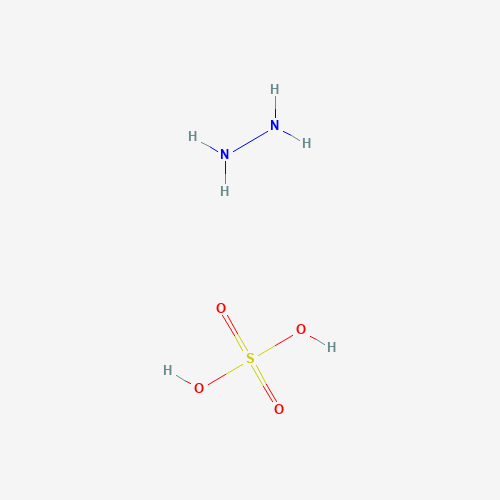
- Reactivity Profile: HYDRAZINE SULFATE is a strong reducing agent. Aqueous solutions are weakly acidic.
- Preventive Measures: SRP: The scientific literature for the use of contact lenses in industry is conflicting. The benefit or detrimental effects of wearing contact lenses depend not only upon the substance, but also on factors including the form of the substance, characteristics and duration of the exposure, the uses of other eye protection equipment, and the hygiene of the lenses. However, there may be individual substances whose irritating or corrosive properties are such that the wearing of contact lenses would be harmful to the eye. In those specific cases, contact lenses should not be worn. In any event, the usual eye protection equipment should be worn even when contact lenses are in place.
- Medical Surveillance: Placement medical examinations shall include at least: comprehensive medical and work histories; comprehensive physical examination; specific clinical tests including complete and differential blood count; liver function tests including serum glutamic-pyruvic transaminase (SGPT), urinalysis including specific gravity, glucose, protein, and microscopic examination, and a 14 x 17 inch posteroanterior chest roentenogram; a judgement of the worker's ability to use positive pressure respirators; and urobilinogen and serum bilirubin tests shall be considered by the responsible physician. Periodic examinations shall be made available at least annually to those working with hydrazines. /Hydrazines/
- RAIS Toxicity Values: Oral Slope Factor Reference: IRIS Current
- TSCA Test Submissions: UNREVIEWED | Hydrazine sulfate was evaluated for genotoxicity in vitro in human Passage 23 WI-38 fibroblasts exposed for 30 minutes to 5 semilog dilutions (concentrations not reported) of the test compound, followed by exposure to 3H-thymidine for 3 hours. Trials were performed on cell cultures both in the presence and absence of Arochlor-induced rat liver S-9 metabolic activation. The rate of unscheduled DNA synthesis (UDS) in hepatocytes was determined by measuring the extent of incorporation of labeled thymidine into DNA, using autoradiography. The maximum rate of UDS in treated cell cultures (1.8 net grains/nucleus) was not significantly greater than that of the negative controls (<1 net grain/ nucleus), indicating that the test compound was negative for UDS in human fibroblasts und...
- Nonfire Spill Response: STORAGE PRECAUTIONS: You should store this material in a refrigerator. (NTP, 1992)
- Air and Water Reactions: Water soluble.
- Human Toxicity Excerpts: /CASE REPORTS/ After 180 mg/day for 2 wks followed by 360 mg/day of hydrazine sulfate ingestion, our patient suffered severe encephalopathy. He received mechanical ventilation with attendant supportive measures and high-dose pyridoxine. The patient's encephalopathy resolved 24 hrs after receiving pyridoxine.
- Isolation and Evacuation: FIRE: If tank, rail tank car or highway tank is involved in a fire, ISOLATE for 800 meters (1/2 mile) in all directions; also, consider initial evacuation for 800 meters (1/2 mile) in all directions. (ERG, 2024)
- Other Safety Information: Chemical Assessment: IMAP assessments - Hydrazine salts: Human health tier II assessment
- Non-Human Toxicity Values: LD50 Rat oral 601 mg/kg
- Populations at Special Risk: Biological half-lives were significantly different among the three acetylation phenotypes (analysis of variance, P < 0.05): 3.94+/-1.70 hours for slow acetylators, 2.25+/-0.37 hours for intermediate acetylators, and 1.86+/-0.67 hours for rapid acetylators. /Hydrazine/
- Hazard Classes and Categories: Carcinogens
- Protective Action Criteria (PAC): PAC-3: 8.8 [mg/m3]
- Personal Protective Equipment (PPE): ... Vinyl coated hand protection, natural or reclaimed rubber protection, rubber aprons, and plastic eye and face protection ... used when working with small quantities. Where possibility of gross splashing exists, full protective clothing made of rubber, neoprene or vinyl-coated materials should be worn. For respiratory protection in situations where recommended tolerance limits are ... exceeded, respiratory protective equipment ... must be used. /Hydrazine and derivatives/
- Skin, Eye, and Respiratory Irritations: Vapors are very irritating to the mucous membranes, nose, throat, and upper respiratory tract. /Hydrazine/
- Hazard Quotient Level 3 or Cancer Risk Level 1E-04: Fraction of Contaminant Absorbed in Gastrointestinal Tract: 1
- Hazard Quotient Level 0.1 or Cancer Risk Level 1E-06: Fraction of Contaminant Absorbed in Gastrointestinal Tract: 1
Warm reminder:
Because the manufacturer may temporarily adjust product specifications, prices, inventory, parameters and other information without notice, and there are differences in each user's consultation time and procurement needs, the platform reply content is only of reference value within a certain period. Sorry for the inconvenience caused to you, and thank you for your understanding and support! Please consult the online customer service for the latest details. Everything is subject to the real-time reply of the customer service.!
Please check the quantity, appearance and product information in time when you receive the goods. In case of damage, wrong delivery, abnormal quality and other problems, please feel free to contact us.
Service Hotline:400-6226-992 ,We will handle it for you as soon as possible, thank you for your support and trust.!
Research chemical CAS 10034-93-2 0. 7g 100ml
Macklin Research chemical CAS 10034-93-2 0. 7g 100ml, complete specifications; suitable for production, research, laboratory testing and inspection; digital one-stop procurement platform for scientific materials.