

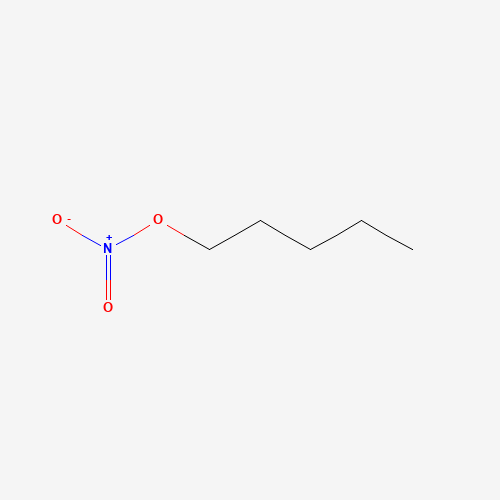
- DOT Label: Flammable Liquid
- First Aid: ERG2024, Guide 128 (Amyl nitrate): In Canada, an Emergency Response Assistance Plan (ERAP) may be required for this product. Please consult the shipping paper and/or the "ERAP" section.
- Fire Hazards: ERG2024, Guide 128 (Amyl nitrate): · If molten aluminum is involved, refer to GUIDE 169.
- Fire Fighting: FIRE INVOLVING TANKS, RAIL TANK CARS OR HIGHWAY TANKS: Fight fire from maximum distance or use unmanned master stream devices or monitor nozzles. Cool containers with flooding quantities of water until well after fire is out. For petroleum crude oil, do not spray water directly into a breached tank car. This can lead to a dangerous boil over. Withdraw immediately in case of rising sound from venting safety devices or discoloration of tank. ALWAYS stay away from tanks in direct contact with flames. For massive fire, use unmanned master stream devices or monitor nozzles; if this is impossible, withdraw from area and let fire burn. (ERG, 2024)
- Toxicity Data: LCLo (mouse) = 1,807 ppm/7hr
- Fire Potential: A flammable liquid.
- Health Hazards: ERG2024, Guide 128 (Amyl nitrate): · Runoff from fire control or dilution water may cause environmental contamination.
- Reactive Group: Nitro, Nitroso, Nitrate, and Nitrite Compounds, Organic
- Adverse Effects: Methemoglobinemia - The presence of increased methemoglobin in the blood; the compound is classified as secondary toxic effect
- Cleanup Methods: Emergency response personal protective equipment: Wear full protective clothing and positive pressure self-contained breathing apparatus. Spill or leak procedures: Stop or control the leak, if this can be done without undue risk. Use water spray to cool and disperse vapors and protect personnel.
- Hazards Summary: Causes convulsions, acute pulmonary edema, and renal tubular changes in inhalation lethal-concentration studies of guinea pigs; Causes convulsions and cyanosis in inhalation lethal-concentration studies of rabbits; [RTECS] A strong oxidizing agent; [CAMEO] May cause mild skin irritation; An eye irritant; May induce methemoglobinemia; [CHRIS] See Butyl nitrate. See Amyl nitrite.
- DOT ID and Guide: 1112 128
- Disposal Methods: Incineration with scrubber to remove nitrogen oxides in effluent gases.
- Toxicity Summary: IDENTIFICATION AND USE: Amyl nitrate is a slightly yellow liquid. It is used in the military, has been used to increase the cetane number of diesel fuels, and is also a component of Otto fuel II. HUMAN STUDIES: Persons exposed in the laboratory during an inhalation study in animals developed nausea and headache. Patients presented with methemoglobinemia following oral ingestion of amyl nitrate. One patient had a methemoglobin fraction of 90.6%. ANIMAL STUDIES: Cats, guinea pigs, rabbits, rats, and mice were exposed to measured concentrations of amyl nitrates in air. The order of decreasing susceptibility is mouse > rat and rabbit > guinea pig > cat. However, except for the cat, which survived all exposures including the highest, 3730 ppm for 7 hr, the differential susceptibility among s...
- Reactivity Alerts: Strong Oxidizing Agent
- Environmental Fate: ATMOSPHERIC FATE: According to a model of gas/particle partitioning of semivolatile organic compounds in the atmosphere(1), n-amyl nitrate, which has a vapor pressure of 5.07 mm Hg at 25 °C(2), is expected to exist solely as a vapor in the ambient atmosphere. Vapor-phase n-amyl nitrate is degraded in the atmosphere by reaction with photochemically-produced hydroxyl radicals(SRC); the half-life for this reaction in air is estimated to be 5 days(SRC), calculated from its rate constant of 3.0X10⁻¹² cu cm/molecule-sec at 25 °C(3). n-Amyl nitrate does not contain chromophores that absorb at wavelengths >290 nm(4) and, therefore, is not expected to be susceptible to direct photolysis by sunlight(SRC).
- Food Survey Values: n-Amyl nitrate has been identified in pork flavor volatiles(1).
- Reactivity Profile: AMYL NITRATE is an oxidizing reagent. When exposed to heat or flame it may decompose to form nitrogen oxides. Accelerates the burning of combustible materials. Can produce a violent reaction with reducing materials [Sax, 9th ed., p. 228].
- Storage Conditions: Store in a cool, dry, well-ventilated location. Outside or detached storage is preferred. Inside storage should be in a standard flammable liquids storage warehouse, room, or cabinet.
- Preventive Measures: Employees should wash immediately with soap when skin is wet or contaminated. Provide emergency showers and eyewash.
- Firefighting Hazards: Vapors are heavier than air and will collect in low areas. Vapors may travel long distances to ignition sources and flashback. Vapors in confined areas may explode when exposed to fire. Storage containers and parts of containers may rocket great distances, in many directions.
- Nonfire Spill Response: LARGE SPILL: Dike far ahead of liquid spill for later disposal. Water spray may reduce vapor, but may not prevent ignition in closed spaces. (ERG, 2024)
- Regulatory Information: New Zealand EPA Inventory of Chemical Status: Amyl Nitrate: HSNO Approval: HSR001085 Approved with controls
- Air and Water Reactions: Flammable. Insoluble in water.
- Human Toxicity Excerpts: /CASE REPORTS/ We wish to report two cases of methemoglobinemia secondary to amyl nitrate use. A 55-year-old male presented with saturations in the mid 80s despite FiO2 of 1.0 and GCS /Glascow Coma Scale/ 10 and a 22-year-old female who presented with fluctuating GCS and a slate grey colour. Both were found to have high levels of methemoglobinemia on ABG /arterial blood gas/, were treated with methylene blue and made excellent recoveries. These cases illustrate the risk of methemoglobinemia secondary to amyl nitrate. Appropriate and prompt management can lead to very good outcomes.
- DOT Emergency Guidelines: /GUIDE 140 OXIDIZERS/ Protective Clothing: Wear positive pressure self-contained breathing apparatus (SCBA). Wear chemical protective clothing that is specifically recommended by the manufacturer. It may provide little or no thermal protection. Structural firefighters' protective clothing will only provide limited protection.
- Fire Fighting Procedures: If material on fire or involved in fire: Do not extinguish fire unless flow can be stopped. Use water in flooding quantities as fog. Solid streams of water may be ineffective. Cool all affected containers with flooding quantities of water. Apply water from as far a distance as possible. Use foam, dry chemical, or carbon dioxide.
- Isolation and Evacuation: Evacuation: ERG2024, Guide 128 (Amyl nitrate): · If tank, rail tank car or highway tank is involved in a fire, ISOLATE for 800 meters (1/2 mile) in all directions; also, consider initial evacuation for 800 meters (1/2 mile) in all directions.
- Soil Adsorption/Mobility: Using a structure estimation method based on molecular connectivity indices(1), the Koc of n-amyl nitrate can be estimated to be 130(SRC). According to a classification scheme(2), this estimated Koc value suggests that n-amyl nitrate is expected to have high mobility in soil(SRC).
- DOT Hazard Classification: Placard/Label(s)
- Other Hazardous Reactions: An oxidixing agent.
- Toxic Combustion Products: Combustion by-products include oxides of nitrogen.
- Atmospheric Concentrations: RURAL/REMOTE: n-Amyl nitrate was present at an average concentration of 4 ptt in samples from a rural site in Egbert, located northwest of Toronto, Ontario, Canada, collected from March 26 - April 27, 1990. A relative formation rate in April of 0.25X10+3/sec was calculated(1). The total butyl and pentyl nitrate concentration ranged from 0.8 to 37 parts/trillion volume in atmospheric samples collected in the North Pacific during April-June 1986(2).
- NFPA Hazard Classification: NFPA Instability Rating: 0 - Materials that in themselves are normally stable, even under fire conditions.
- Accidental Release Measures: Spill or Leak: ERG2024, Guide 128 (Amyl nitrate): · Water spray may reduce vapor, but may not prevent ignition in closed spaces.
- Non-Human Toxicity Excerpts: /OTHER TOXICITY INFORMATION/ ... Cats, guinea pigs, rabbits, rats, and mice /were exposed/ to measured concentrations of amyl nitrates in air. ... The order of decreasing susceptibility is mouse > rat and rabbit > guinea pig > cat. However, except for the cat, which survived all exposures including the highest, 3730 ppm for 7 hr, the differential susceptibility among species was small. All species survived exposures of 600 ppm for 10 days at 7 hr/day or 262 ppm for 20 days at 7 hr/day. High lethal levels of amyl nitrate produced signs and symptoms which were characterized by tremors, ataxia, alterations in respiration, lethargy, cyanosis, convulsions, coma, and deaths. All exposures except 262 ppm produced signs in cats and guinea pigs, and some alterations in respiration were observed...
- Artificial Pollution Sources: n-Amyl nitrate's production and use in specific fuel formulations and former use as a diesel fuel additive(1) will result in its direct release to the environment(SRC). Organic nitrates, such as pentyl nitrate, are produced from the atmospheric oxidation of alkanes in the presence of high amounts of nitrogen oxide [NO](2).
- Hazard Classes and Categories: Flammable agents - 2nd degree
- Environmental Bioconcentration: An estimated BCF of 29 was calculated in fish for n-amyl nitrate(SRC), using an estimated log Kow of 2.72(1) and a regression-derived equation(1). According to a classification scheme(2), this BCF suggests the potential for bioconcentration in aquatic organisms is low(SRC).
- Volatilization from Water/Soil: The Henry's Law constant for n-amyl nitrate is 1.6X10⁻³ atm-cu m/mole(1). This Henry's Law constant indicates that n-amyl nitrate is expected to volatilize from water surfaces(2). Based on this Henry's Law constant, the volatilization half-life from a model river (1 m deep, flowing 1 m/sec, wind velocity of 3 m/sec)(2) is estimated as 4 hours(SRC). The volatilization half-life from a model lake (1 m deep, flowing 0.05 m/sec, wind velocity of 0.5 m/sec)(2) is estimated as 5 days(SRC). n-Amyl nitrate is expected to volatilize from dry soil surfaces(SRC) based upon a vapor pressure of 5.07 mm Hg(1).
- Antidote and Emergency Treatment: If this chemical gets into the eyes, remove any contact lenses at once and irrigate immediately for at least 15 min, occasionally lifting upper and lower lids. Seek medical attention immediately. If this chemical contacts the skin, remove contaminated clothing and wash immediately with soap and water. Seek medical attention immediately. If this chemical has been inhaled, remove from exposure, begin rescue breathing (using universal precautions, including resuscitation mask) if breathing has stopped and CPR if heart action has stopped. Transfer promptly to a medical facility. When this chemical has been swallowed, get medical attention.
- Protective Action Criteria (PAC): PAC-3: 93 [ppm]
- Shipment Methods and Regulations: The International Maritime Dangerous Goods Code lays down basic principles for transporting hazardous chemicals. Detailed recommendations for individual substances and a number of recommendations for good practice are included in the classes dealing with such substances. A general index of technical names has also been compiled. This index should always be consulted when attempting to locate the appropriate procedures to be used when shipping any substance or article. Amyl nitrate is included on the dangerous goods list.
- Environmental Abiotic Degradation: The rate constant for the vapor-phase reaction of n-amyl nitrate with photochemically-produced hydroxyl radicals is 3.0X10⁻¹² cu cm/molecule-sec at 25 °C(1). This corresponds to an atmospheric half-life of about 5 days at an atmospheric concentration of 5X10+5 hydroxyl radicals per cu cm(1). n-Amyl nitrate is expected to undergo hydrolysis in the environment due to the presence of functional groups that hydrolyze under environmental conditions(2). n-Amyl nitrate does not contain chromophores that absorb at wavelengths >290 nm(2) and, therefore, is not expected to be susceptible to direct photolysis by sunlight(SRC).
- Probable Routes of Human Exposure: NIOSH (NOES Survey 1981-1983) has statistically estimated that 82 workers were potentially exposed to n-amyl nitrate in the US(1). Occupational exposure to n-amyl nitrate may occur through inhalation and dermal contact with this compound at workplaces where n-amyl nitrate is produced or used. Limited monitoring data indicate that the general population may be exposed to n-amyl nitrate via inhalation of ambient air and air of some cooked meats(SRC).
- Other Environmental Concentrations: n-Amyl nitrate was detected, not quantified in volatiles from microbial degradation of stored food exudate(1).
- Environmental Fate/Exposure Summary: n-Amyl nitrate's production and use in specific fuel formulations and former use as a diesel fuel additive will result in its direct release to the environment. If released to air, a vapor pressure of 5.07 mm Hg at 25 °C indicates n-amyl nitrate will exist solely as a vapor in the atmosphere. Vapor-phase n-amyl nitrate will be degraded in the atmosphere by reaction with photochemically-produced hydroxyl radicals; the half-life for this reaction in air is estimated to be 5 days. n-Amyl nitrate does not contain chromophores that absorb at wavelengths >290 nm and, therefore, is not expected to be susceptible to direct photolysis by sunlight. If released to soil, amyl nitrate is expected to have high mobility based upon an estimated Koc of 130. Volatilization from moist soil surfaces is exp...
- Personal Protective Equipment (PPE): Wear protective gloves and clothing to prevent any reasonable probability of skin contact. ... All protective clothing (suits, gloves, footwear, headgear) should be clean, available each day, and put on before work. ... Wear splash-proof chemical goggles and face shield unless full face-piece respiratory protection is worn.
- Shipping Name/ Number DOT/UN/NA/IMO: IMO 3; Amyl nitrate
- Emergency Response Planning Guidelines: Emergency Response: ERG2024, Guide 128 (Amyl nitrate): · For massive fire, use unmanned master stream devices or monitor nozzles; if this is impossible, withdraw from area and let fire burn.
- Exposure Control and Personal Protection: Protective Clothing: ERG2024, Guide 128 (Amyl nitrate): · Structural firefighters' protective clothing provides thermal protection but only limited chemical protection.
- Hazardous Reactivities and Incompatibilities: Contact with reducing agents or other easily oxidizable substances may cause fire and explosions.
Warm reminder:
Because the manufacturer may temporarily adjust product specifications, prices, inventory, parameters and other information without notice, and there are differences in each user's consultation time and procurement needs, the platform reply content is only of reference value within a certain period. Sorry for the inconvenience caused to you, and thank you for your understanding and support! Please consult the online customer service for the latest details. Everything is subject to the real-time reply of the customer service.!
Please check the quantity, appearance and product information in time when you receive the goods. In case of damage, wrong delivery, abnormal quality and other problems, please feel free to contact us.
Service Hotline:400-6226-992 ,We will handle it for you as soon as possible, thank you for your support and trust.!
nitroacidn-pentylester 97% 5/ml
nitroacidn-pentylester 97% 5/ml Macklin 1002-16-0, available in complete specifications for production, research, laboratory testing and inspection; digital one-stop procurement platform for scientific materials




