

- DOT Label: Poison
- First Aid: OTHER: Since this chemical is a known or suspected carcinogen you should contact a physician for advice regarding the possible long term health effects and potential recommendation for medical monitoring. Recommendations from the physician will depend upon the specific compound, its chemical, physical and toxicity properties, the exposure level, length of exposure, and the route of exposure. (NTP, 1992)
- Fire Hazards: Not combustible. Gives off irritating or toxic fumes (or gases) in a fire. Risk of fire and explosion on contact with metals. See Chemical Dangers.
- Safe Storage: Store in an area without drain or sewer access. Well closed. Separated from acids and food and feedstuffs.
- Fire Fighting: In case of fire in the surroundings, use appropriate extinguishing media.
- Eye Prevention: Wear face shield or eye protection in combination with breathing protection if powder.
- Health Hazards: ACUTE/CHRONIC HAZARDS: This compound may be fatal if swallowed, inhaled or absorbed through the skin. It may cause irritation to the skin, eyes, nose and throat. When heated to decomposition it emits toxic fumes of arsenic oxides. (NTP, 1992)
- Reactive Group: Oxidizing Agents, Weak
- Adverse Effects: ACGIH Carcinogen - Confirmed Human.
- Exposure Routes: The substance can be absorbed into the body by inhalation of its aerosol and by ingestion.
- Hazards Summary: A skin, eye, and respiratory tract irritant; May cause arsenic poisoning; [ICSC] Dibasic sodium arsenate contains 40% arsenic in the anhydrous form and 24% arsenic in the more common hydrate form; Intraperitoneal TDLo (mouse) = 43 mg/kg; [Ullmann] See Sodium arsenate, dibasic. See Arsenic and the linked occupational diseases.
- Inhalation Risk: A harmful concentration of airborne particles can be reached quickly when dispersed.
- Skin Prevention: Protective gloves. Protective clothing.
- Special Reports: IARC. Monographs on the Evaluation of the Carcinogenic Risk of Chemicals to Man. Geneva: World Health Organization, International Agency for Research on Cancer, 1972-PRESENT. (Multivolume work). Volume 84 (2004). Some Drinking-water Disinfectants and Contaminants, including Arsenic.[Available from, as of July 22, 2009: http://monographs.iarc.fr/ENG/Monographs/vol84/volume84.pdf]
- Disposal Methods: SRP: At the time of review, criteria for land treatment or burial (sanitary landfill) disposal practices are subject to significant revision. Prior to implementing land disposal of waste residue (including waste sludge), consult with environmental regulatory agencies for guidance on acceptable disposal practices.
- EC Classification: Symbol: T, N; R: 45-23/25-50/53; S: 53-45-60-61; Note: A, E
- Spillage Disposal: Personal protection: chemical protection suit including self-contained breathing apparatus. Do NOT let this chemical enter the environment. Sweep spilled substance into covered containers. If appropriate, moisten first to prevent dusting. Carefully collect remainder. Then store and dispose of according to local regulations.
- UN Classification: UN Hazard Class: 6.1; UN Pack Group: II
- First Aid Measures: Ingestion First Aid: Rinse mouth. Give a slurry of activated charcoal in water to drink. Refer for medical attention .
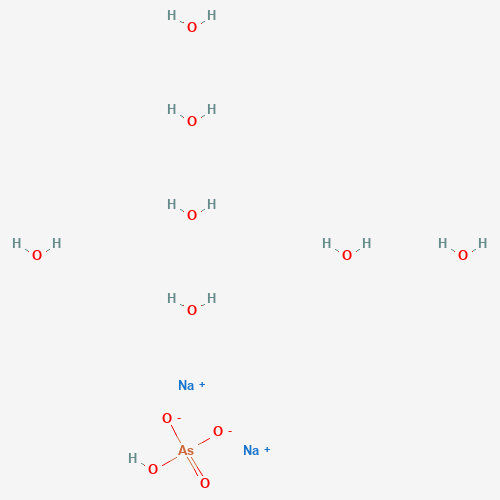
- Reactivity Profile: Sodium arsenate heptahydrate is a weak oxidizing agent, and may react with strong or weak reducing agents.
- Signs and Symptoms: Ingestion Exposure: Abdominal pain. Burning sensation. Diarrhoea. Vomiting. Shock or collapse.
- Exposure Prevention: PREVENT DISPERSION OF DUST! AVOID ALL CONTACT! IN ALL CASES CONSULT A DOCTOR!
- Ingestion Prevention: Do not eat, drink, or smoke during work. Wash hands before eating.
- Inhalation Prevention: Use closed system or ventilation.
- Nonfire Spill Response: STORAGE PRECAUTIONS: You should store this chemical at ambient temperatures, and keep it away from oxidizing materials and acids. (NTP, 1992)
- Regulatory Information: New Zealand EPA Inventory of Chemical Status: Sodium arsenate, dibasic, heptahydrate: HSNO Approval: HSR006141 Approved with controls
- Air and Water Reactions: Effloresces in warm air. Water soluble.
- ICSC Environmental Data: This substance may be hazardous to the environment. Special attention should be given to ground water contamination, aquatic organisms and soil organisms. This substance does enter the environment under normal use. Great care, however, should be taken to avoid any additional release, for example through inappropriate disposal.
- Packaging and Labelling: Unbreakable packaging. Put breakable packaging into closed unbreakable container. Do not transport with food and feedstuffs. Marine pollutant.
- Isolation and Evacuation: FIRE: If tank, rail tank car or highway tank is involved in a fire, ISOLATE for 800 meters (1/2 mile) in all directions; also, consider initial evacuation for 800 meters (1/2 mile) in all directions. (ERG, 2024)
- Other Safety Information: Chemical Assessment: Evaluation - Water soluble arsenic compounds
- Evidence for Carcinogenicity: CLASSIFICATION: A; human carcinogen. BASIS FOR CLASSIFICATION: Based on sufficient evidence from human data. An increased lung cancer mortality was observed in multiple human populations exposed primarily through inhalation. Also, increased mortality from multiple internal organ cancers (liver, kidney, lung, and bladder) and an increased incidence of skin cancer were observed in populations consuming drinking water high in inorganic arsenic. HUMAN CARCINOGENICITY DATA: Sufficient. ANIMAL CARCINOGENICITY DATA: Inadequate. /Inorganic Arsenic/ /Based on former classification system/
- Threshold Limit Values (TLV): 0.01 mg/m
- Effects of Long Term Exposure: Repeated or prolonged contact with skin may cause dermatitis. The substance may have effects on the peripheral nervous system, mucous membranes, skin, cardiovascular system, bone marrow, kidneys and liver. This may result in neuropathy, pigmentation disorders, perforation of the nasal septum, lesions of blood cells, kidney impairment and cirrhosis. This substance is carcinogenic to humans. Animal tests show that this substance possibly causes toxicity to human reproduction or development.
- Hazard Classes and Categories: Acute toxicity (inhalation) - category 3
- Effects of Short Term Exposure: The substance is irritating to the eyes, skin and respiratory tract. The substance may cause effects on the cardiovascular system, central nervous system, gastrointestinal tract and kidneys. This may result in cardiac disorders, severe gastroenteritis, loss of fluids and electrolytes, kidney impairment, collapse and shock. Exposure far above the OEL could cause death. The effects may be delayed. Medical observation is indicated.
- Permissible Exposure Limit (PEL): 0.01 [mg/m3], as As
- Occupational Exposure Limits (OEL): MAK (Maximale Arbeitsplatz Konzentration): skin absorption (H); carcinogen category: 1; germ cell mutagen group: 3A.
- Personal Protective Equipment (PPE): RECOMMENDED RESPIRATOR: Where the neat test chemical is weighed and diluted, wear a NIOSH-approved half face respirator equipped with an organic vapor/acid gas cartridge (specific for organic vapors, HCl, acid gas and SO2) with a dust/mist filter. (NTP, 1992)
- Exposure Control and Personal Protection: Exposure Summary: Biological Exposure Indices (BEI) [ACGIH] - Inorganic arsenic plus methylated metabolites in urine = 35 ug As/L; end of workweek
- Immediately Dangerous to Life or Health (IDLH): 5.0 [mg/m3], as As
Warm reminder:
Because the manufacturer may temporarily adjust product specifications, prices, inventory, parameters and other information without notice, and there are differences in each user's consultation time and procurement needs, the platform reply content is only of reference value within a certain period. Sorry for the inconvenience caused to you, and thank you for your understanding and support! Please consult the online customer service for the latest details. Everything is subject to the real-time reply of the customer service.!
Please check the quantity, appearance and product information in time when you receive the goods. In case of damage, wrong delivery, abnormal quality and other problems, please feel free to contact us.
Service Hotline:400-6226-992 ,We will handle it for you as soon as possible, thank you for your support and trust.!
Research chemical CAS 10048-95-0 ACS; ≥98%; 1g
Research chemical CAS 10048-95-0 ACS; ≥98%; 1g; supplied for laboratory research, analysis, inspection, and scientific procurement use; specifications: ACS; ≥98%; 1g.




