

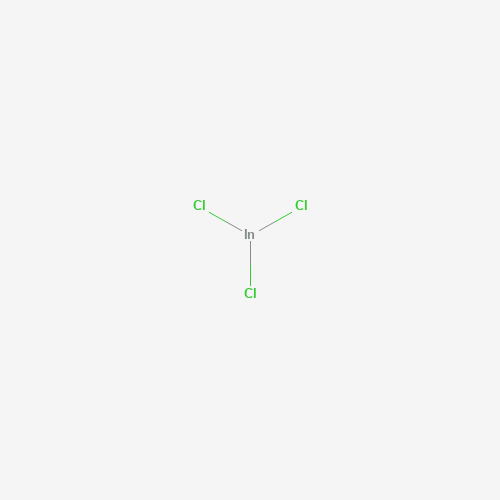
- Fire Hazards: Not combustible.
- Interactions: An investigation was conducted to evaluate the influence of some iron chelators of the group of 1,2-dialkyl-3-hydroxypyridin-4-ones on the lipid peroxidation and glutathione depletion. Male ICR-mice and SPF-mice were dosed with indium-chloride (10025828), carbon-tetrachloride (56235) or cadmium-chloride (10108642). Subcutaneous administration of the chelators was able to reduce the lipid peroxidation enhanced by indium pretreatment. The direct binding of indium was presumed...
- Safe Storage: Separated from strong acids. Well closed.
- Fire Fighting: In case of fire in the surroundings, use appropriate extinguishing media.
- Eye Prevention: Wear safety goggles or eye protection in combination with breathing protection.
- Fire Potential: Not combustible.
- Adverse Effects: Toxic Pneumonitis - Inflammation of the lungs induced by inhalation of metal fumes or toxic gases and vapors.
- Cleanup Methods: Sweep spilled substance into covered containers. Carefully collect remainder, then remove to safe place. Do NOT let this chemical enter the environment.
- Exposure Routes: The substance can be absorbed into the body by inhalation and by ingestion.
- Hazards Summary: A corrosive substance that can cause injury to the skin, eyes, and respiratory tract; Inhalation may cause pulmonary edema; The substance may have effects on the kidneys, resulting in kidney impairment. Animal tests show that this substance possibly causes malformations in human babies. [ICSC] A corrosive substance that can cause injury to the skin, eyes, and respiratory tract; Inhalation may cause chemical pneumonitis; Effects in high-dose animal studies include acute tubular necrosis; [MSDSonline] See Indium.
- Inhalation Risk: A harmful concentration of airborne particles can be reached quickly when dispersed, especially if powdered.
- Skin Prevention: Protective gloves. Protective clothing.
- Disposal Methods: Storage and disposal of Indium (111)In Chloride Sterile Solution should be controlled in a manner that is in compliance with the appropriate regulations of the government agency authorized to license the use of the radionuclide. The vial should be kept inside its transportation shield whenever possible and should be handled with forceps when contents are being removed.
- FDA Requirements: The Approved Drug Products with Therapeutic Equivalence Evaluations identifies currently marketed prescription drug products, including indium In-III chloride, approved on the basis of safety and effectiveness by FDA under sections 505 of the Federal Food, Drug, and Cosmetic Act.
- Spillage Disposal: Personal protection: particulate filter respirator adapted to the airborne concentration of the substance. Do NOT let this chemical enter the environment. Sweep spilled substance into covered containers. Carefully collect remainder. Then store and dispose of according to local regulations.
- First Aid Measures: Ingestion First Aid: Rinse mouth. Do NOT induce vomiting. Give one or two glasses of water to drink. Refer for medical attention .
- Signs and Symptoms: Ingestion Exposure: Burning sensation. Abdominal pain. Nausea. Vomiting. Shock or collapse.
- Storage Conditions: Separated from strong acids. Well closed.
- Exposure Prevention: STRICT HYGIENE! AVOID EXPOSURE OF (PREGNANT) WOMEN! IN ALL CASES CONSULT A DOCTOR!
- Preventive Measures: Do not eat, drink, or smoke during work. Wash hands before eating.
- Ingestion Prevention: Do not eat, drink, or smoke during work. Wash hands before eating.
- Inhalation Prevention: Use local exhaust or breathing protection.
- NIOSH Recommendations: Recommended Exposure Limit: 10 hr Time Weighted Avg: 0.1 mg/cu m. [Note: The REL also applies to other indium compounds (as In).] /Indium/
- Regulatory Information: New Zealand EPA Inventory of Chemical Status: Indium chloride (InCl3): Does not have an individual approval but may be used under an appropriate group standard
- Human Toxicity Excerpts: /OTHER TOXICITY INFORMATION/ The substance is corrosive to the eyes, the skin and the respiratory tract. Inhalation of the substance may cause lung edema
- ICSC Environmental Data: Environmental effects from the substance have not been investigated adequately.
- Non-Human Toxicity Values: LD50 Mouse ip 9500 ug/kg
- Other Hazardous Reactions: Evaporation at 20 °C is negligible; a harmful concentration of airborne particles can, however, be reached quickly when dispersed, especially if powdered
- Toxic Combustion Products: When heated to decomposition it emits toxic fumes of /chlorides/.
- Threshold Limit Values (TLV): (as In): 0.1 mg/m
- Effects of Long Term Exposure: The substance may have effects on the kidneys. This may result in kidney impairment. Animal tests show that this substance possibly causes malformations in human babies.
- Hazard Classes and Categories: Specific target organ toxicity - Single exposure - Category 1 (lung)
- Effects of Short Term Exposure: The substance is corrosive to the eyes, skin and respiratory tract. Inhalation may cause lung oedema.
- Radiation Limits and Potential: The contents of the vial are radioactive and adequate shielding and handling precautions must be maintained. Store at controlled room temperature 20-25 °C (68-77 °F) /In-111/
- Volatilization from Water/Soil: Due to their ionic nature, indium salts are expected to exist as ions in the environment and, therefore, volatilization from water surfaces will not be an important fate process. (SRC)
- Antidote and Emergency Treatment: /SRP:/ Advanced treatment: Consider orotracheal or nasotracheal intubation for airway control in the patient who is unconscious, has severe pulmonary edema, or is in severe respiratory distress. Positive-pressure ventilation techniques with a bag valve mask device may be beneficial. Consider drug therapy for pulmonary edema ... . Consider administering a beta agonist such as albuterol for severe bronchospasm ... . Monitor cardiac rhythm and treat arrhythmias as necessary ... . Start IV administration of D5W /SRP: "To keep open", minimal flow rate/. Use 0.9% saline (NS) or lactated Ringer's if signs of hypovolemia are present. For hypotension with signs of hypovolemia, administer fluid cautiously. Watch for signs of fluid overload ... . Treat seizures with diazepam or lorazepam ... . Use...
- Protective Action Criteria (PAC): PAC-3: 0.94 [mg/m3]
- Probable Routes of Human Exposure: NIOSH (NOES Survey 1981-1983) has statistically estimated that 14 workers (none of these were female) were potentially exposed to indium trichloride in the US(1).
- Personal Protective Equipment (PPE): Personal protection: P3 filter respirator for toxic particles.
- Hazardous Reactivities and Incompatibilities: Reacts with strong acids.
Warm reminder:
Because the manufacturer may temporarily adjust product specifications, prices, inventory, parameters and other information without notice, and there are differences in each user's consultation time and procurement needs, the platform reply content is only of reference value within a certain period. Sorry for the inconvenience caused to you, and thank you for your understanding and support! Please consult the online customer service for the latest details. Everything is subject to the real-time reply of the customer service.!
Please check the quantity, appearance and product information in time when you receive the goods. In case of damage, wrong delivery, abnormal quality and other problems, please feel free to contact us.
Service Hotline:400-6226-992 ,We will handle it for you as soon as possible, thank you for your support and trust.!
Research chemical CAS 10025-82-8 ≥99. 999% 100g
Research chemical CAS 10025-82-8 ≥99. 999% 100g, complete specifications; suitable for production, research, laboratory testing and inspection; digital one-stop procurement platform for scientific materials.




