
- DOT Label: Corrosive
- First Aid: ERG2024, Guide 157 (Silicon tetrachloride): In Canada, an Emergency Response Assistance Plan (ERAP) may be required for this product. Please consult the shipping paper and/or the "ERAP" section.
- AEGLs Notes: AEGLs Status: Final
- AEGLs Table: 8 hr: 6.5
- Fire Hazards: Not combustible. Gives off irritating or toxic fumes (or gases) in a fire.
- Safe Storage: Keep under inert gas. Separated from food and feedstuffs and incompatible materials. See Chemical Dangers. Dry. Well closed. Keep in a well-ventilated room.
- Fire Fighting: NO water. In case of fire in the surroundings, use appropriate extinguishing media. In case of fire: keep drums, etc., cool by spraying with water. NO direct contact with water.
- Toxicity Data: LC50 (rat) = 8,000 ppm/4H
- Eye Prevention: Wear face shield or eye protection in combination with breathing protection.
- Fire Potential: CERTAIN STRONG CORROSIVES MAY, ON CONTACT WITH ORGANIC MATTER OR OTHER CHEMICALS, CAUSE FIRE... /CORROSIVE SUBSTANCES/
- Health Hazards: ERG2024, Guide 157 (Silicon tetrachloride): · Runoff from fire control or dilution water may be corrosive and/or toxic and cause environmental contamination.
- Reactive Group: Chlorosilanes
- Adverse Effects: Toxic Pneumonitis - Inflammation of the lungs induced by inhalation of metal fumes or toxic gases and vapors.
- Cleanup Methods: Spills can be rendered harmless by anhydrous soda.
- Exposure Routes: The substance can be absorbed into the body by inhalation of its vapour and by ingestion.
- Hazards Summary: Decomposes in water to release hydrochloric acid; [Merck Index # 8500] Contact can cause severe burns to skin and eyes; Inhalation can cause pulmonary edema; [CAMEO] Silicon tetrachloride is a skin irritant. [Quick CPC] Corrosive to rabbit skin when applied undiluted; In a spill accident, several people were treated for burning of the eyes and respiratory tract; in most cases, symptoms cleared within 24 hours; [AIHA]
- Inhalation Risk: No indication can be given about the rate at which a harmful concentration of this substance in the air is reached on evaporation at 20 °C.
- Skin Prevention: Protective gloves. Protective clothing.
- DOT ID and Guide: 1818 157
- Disposal Methods: /LABORATORY QUANTITIES/: Chemical treatment: Transfer into an evaporating dish containing sodium bicarbonate. Spray with ammonia (6m-NH4OH) /6 M-ammonium hydroxide/ while stirring and then spread with crushed ice. Continue spraying with ammonia until the smoke of ammonium chloride partly subsides and add iced water while stirring. Neutralize and slowly transfer the mixture into a drain with running water.
- Physical Dangers: The vapour is heavier than air.
- EC Classification: Symbol: Xi; R: 14-36/37/38; S: (2)-7/8-26
- Reactivity Alerts: Air-Reactive
- Spillage Disposal: Personal protection: chemical protection suit including self-contained breathing apparatus. Ventilation. Collect leaking and spilled liquid in sealable containers as far as possible. Absorb remaining liquid in dry sand or inert absorbent. Then store and dispose of according to local regulations.
- UN Classification: UN Hazard Class: 8; UN Pack Group: II
- First Aid Measures: Ingestion First Aid: Rinse mouth. Do NOT induce vomiting. Give nothing to drink. Refer for medical attention .
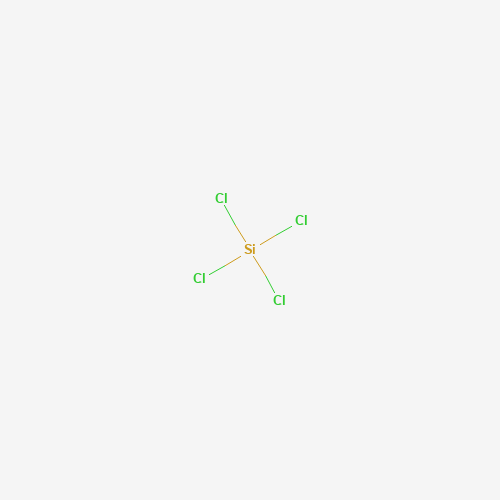
- Reactivity Profile: Chlorosilanes, such as SILICON TETRACHLORIDE, are compounds in which silicon is bonded to from one to four chlorine atoms with other bonds to hydrogen and/or alkyl groups. Chlorosilanes react with water, moist air, or steam to produce heat and toxic, corrosive fumes of hydrogen chloride. They may also produce flammable gaseous H2. They can serve as chlorination agents. Chlorosilanes react vigorously with both organic and inorganic acids and with bases to generate toxic or flammable gases. This material is incompatible with alkali metals and dimethyl sulfoxide.
- Signs and Symptoms: Ingestion Exposure: Burning sensation. Abdominal pain. Shock or collapse.
- Storage Conditions: ALL CONTAINERS, PIPES, APPARATUS, INSTALLATIONS & STRUCTURES USED FOR MFR, STORAGE, TRANSPORT OR USE OF THESE SUBSTANCES MUST BE OF MATERIAL RESISTANT TO CORROSIVE SUBSTANCES OR BE PROTECTED BY SUITABLE COATINGS... ALL CONTAINERS OR RECEPTACLES SHOULD BE CLEARLY LABELLED TO INDICATE THEIR CONTENTS & SHOULD BEAR DANGER SYMBOL FOR CORROSIVES. /CORROSIVE SUBSTANCES/
- Exposure Prevention: STRICT HYGIENE! IN ALL CASES CONSULT A DOCTOR!
- Preventive Measures: ...PREVENTIVE MEASURES SHOULD BE DIRECTED PRIMARILY AT PREVENTING OR MINIMIZING CONTACT BETWEEN CORROSIVE SUBSTANCES & SKIN, MUCOUS MEMBRANES & EYES. ... ADEQUATE VENTILATION & EXHAUST ARRANGEMENTS, WHETHER GENERAL OR LOCAL, SHOULD BE PROVIDED WHENEVER CORROSIVE GASES OR DUSTS ARE PRESENT. ... THE MOST SATISFACTORY METHOD OF ENSURING WORKER PROTECTION IS TO PREVENT...CONTACT WITH CORROSIVE SUBSTANCES BY UTILIZING ONLY CLOSED-CIRCUIT APPARATUS. ... IT IS GOOD PRACTICE TO INSTALL EMERGENCY SHOWERS AT ALL STRATEGIC LOCATIONS...BATH TUBS FILLED WITH CLEAN WATER CAN ALSO PROVIDE VALUABLE SERVICE IN...EMERGENCY. /CORROSIVE SUBSTANCES/
- Firefighting Hazards: Contact with water in foam applied to adjacent fires will produce irritating fumes of hydrogen chloride.
- Ingestion Prevention: Do not eat, drink, or smoke during work.
- Inhalation Prevention: Use ventilation, local exhaust or breathing protection.
- Hazards Identification: ERG Hazard Classes: Water-reactive material (WR)
- Nonfire Spill Response: SMALL SPILL: Cover with DRY earth, DRY sand or other non-combustible material followed with plastic sheet to minimize spreading or contact with rain. Use clean, non-sparking tools to collect material and place it into loosely covered plastic containers for later disposal. (ERG, 2024)
- Air and Water Reactions: Silicon tetrachloride reacts vigorously with water to generate gaseous HCl. Based on a scenario where the chemical is spilled into an excess of water (at least 5 fold excess of water), half of the maximum theoretical yield of Hydrogen Chloride gas will be created in 0.38 minutes. Experimental details are in the following: "Development of the Table of Initial Isolation and Protective Distances for the 2008 Emergency Response Guidebook", ANL/DIS-09-2, D.F. Brown, H.M. Hartmann, W.A. Freeman, and W.D. Haney, Argonne National Laboratory, Argonne, Illinois, June 2009.
- Packaging and Labelling: Do not transport with food and feedstuffs.
- CSL Reaction Information: Create Date: 04/21/2022
- Fire Fighting Procedures: Materials and methods used for the field testing of foams on silicon tetrachloride are described. Two foams were tested incl a high water retention foam with stability over a wide pH range & an ammoniated foam that converts the chlorine portion of the foams to ammonium chloride rather than hydrogen chloride. Results show the application of foam significantly reduced the vapor hazard from spilled silicon tetrachloride.
- Isolation and Evacuation: Protection: - PROTECT people from downwind during NIGHT time: 2.0 km (1.3 mi)
- DOT Hazard Classification: Placard/Label(s)
- Accidental Release Measures: Spill or Leak: ERG2024, Guide 157 (Silicon tetrachloride): · Use clean, non-sparking tools to collect material and place it into loosely covered plastic containers for later disposal.
- Non-Human Toxicity Excerpts: /VIA INHALATION/ THEY HAVE A CORROSIVE ACTION WHEN BROUGHT INTO CONTACT WITH MUCOUS MEMBRANES. /CHLOROSILANES/
- Hazard Classes and Categories: Eye Irrit. 2
- Toxic-by-Inhalation (TIH) Gas: HCl - when spill Silicon tetrachloride into water.
- Effects of Short Term Exposure: The substance and the vapour are corrosive to the eyes, skin and respiratory tract. Corrosive on ingestion. Inhalation of the vapour may cause lung oedema. Inhalation of the vapour may cause asthma-like reactions. The effects may be delayed. Exposure could cause death. Medical observation is indicated.
- Standard Transportation Number: 49 323 70; Silicon chloride, silicon tetrachloride
- DHS Chemicals of Interest (COI): Security Issue: Sabotage/Contamination: Chemical or material that can be mixed with readily available materials.
- Antidote and Emergency Treatment: Advanced treatment: Consider orotracheal or nasotracheal intubation for airway control in the patient who is unconscious or in respiratory arrest. Positive-pressure ventilation techniques with a bag-valve-mask device may be beneficial. Monitor cardiac rhythm and treat arrhythmias if necessary ... . Start an IV with D5W TKO /SRP: "To keep open", minimal flow rate/. Use lactated Ringer's to support vital signs if signs of hypovolemia are present. Watch for signs of fluid overload. Consider drug therapy for pulmonary edema ... . Consider vasopressors to treat hypotension without signs of hypovolemia ... . Use proparacaine hydrochloride to assist eye irrigation ... . /Chlorine and related compounds/
- Protective Action Criteria (PAC): PAC-3: 25 [ppm]
- Shipment Methods and Regulations: The International Maritime Dangerous Goods Code lays down basic principles for transporting hazardous chemicals. Detailed recommendations for individual substances and a number of recommendations for good practice are included in the classes dealing with such substances. A general index of technical names has also been compiled. This index should always be consulted when attempting to locate the appropriate procedures to be used when shipping any substance or article.
- Critical Temperature and Pressure: Critical temperature: 472.5 °F; Critical pressure: 36.8 atmospheres
- Personal Protective Equipment (PPE): ...NATURAL RUBBERS, SYNTHETIC RUBBERS, POLYVINYL CHLORIDE, POLYPROPYLENE OR POLYETHYLENE EITHER IN SHEET FORM OR WITH FABRIC BACKING ARE SUITABLE /FOR PERSONAL PROTECTIVE EQUIPMENT/. /CORROSIVE SUBSTANCES/
- Shipping Name/ Number DOT/UN/NA/IMO: IMO 8.0; Silicon tetrachloride
- Emergency Response Planning Guidelines: ERPG-3: 37 ppm - one hour exposure limit: 3 = life threatening health effects [AIHA]
- Skin, Eye, and Respiratory Irritations: HAZARD WARNING: THE VAPORS HAVE ADEQUATE WARNING PROPERTIES OF IRRITATION OF THE EYE, NOSE, & RESP PASSAGES BEFORE SUFFICIENT EXPOSURE OCCURS TO CAUSE INJURY TO THE EYES. THE PRINCIPAL DANGER IS FROM SPLASH CONTAMINATION. /CHLOROSILANES/
- Exposure Control and Personal Protection: Exposure Summary: TIH (Toxic Inhalation Hazard) - Term used to describe gases and volatile liquids that are toxic when inhaled. Some are TIH materials themselves, e.g., chlorine, and some release TIH gases when spilled in water, e.g., chlorosilanes. [ERG 2016].
Warm reminder:
Because the manufacturer may temporarily adjust product specifications, prices, inventory, parameters and other information without notice, and there are differences in each user's consultation time and procurement needs, the platform reply content is only of reference value within a certain period. Sorry for the inconvenience caused to you, and thank you for your understanding and support! Please consult the online customer service for the latest details. Everything is subject to the real-time reply of the customer service.!
Please check the quantity, appearance and product information in time when you receive the goods. In case of damage, wrong delivery, abnormal quality and other problems, please feel free to contact us.
Service Hotline:400-6226-992 ,We will handle it for you as soon as possible, thank you for your support and trust.!
Research chemical CAS 10026-04-7 1. 0M 100ml
Yuanye Research chemical CAS 10026-04-7 1. 0M 100ml, complete specifications; suitable for production, research, laboratory testing and inspection; digital one-stop procurement platform for scientific materials.