

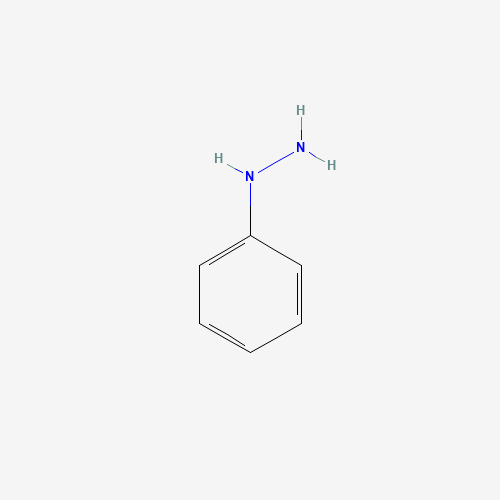
- DOT Label: Poison
- First Aid: Swallow: Medical attention immediately - If this chemical has been swallowed, get medical attention immediately.
- Cancer Sites: [in animals: tumors of the lungs, liver, blood vessels & intestine]
- Fire Hazards: Combustible. Gives off irritating or toxic fumes (or gases) in a fire. Above 88 °C explosive vapour/air mixtures may be formed.
- Interactions: The peroxidation induced by phenylhydrazine in rats chronically exposed to lead was evaluated. Wistar-rats were exposed to lead in-utero and up to four months after birth via administration of distilled drinking water containing ...lead-acetate. The animals were then maintained in a closed desiccator system for analysis of exhaled hydrocarbons before or immediately after injection of phenylhydrazine. The effect of chronic lead pretreatment was assessed by measuring the production of the four main volatile hydrocarbons: ethane and pentane as indices of lipid peroxidation; propane as a marker of protein peroxidation; and ethylene as an index of both lipid and protein peroxidations. Lead alone did not increase the physiological formation of alkanes. After phenylhydrazine injection, lipid p...
- Safe Storage: Separated from strong oxidants and food and feedstuffs. Store in an area without drain or sewer access.
- Fire Fighting: Use water spray, alcohol-resistant foam, powder, carbon dioxide. In case of fire: keep drums, etc., cool by spraying with water.
- Target Organs: Blood, respiratory system, liver, kidneys, skin
- Toxicity Data: LC50 (rat) = 2,610 mg/m3
- Eye Prevention: Wear face shield or eye protection in combination with breathing protection.
- Fire Potential: Flammable when exposed to heat, flame, or oxidizers.
- Health Hazards: ERG2024, Guide 153 (Phenylhydrazine): · Runoff from fire control or dilution water may be corrosive and/or toxic and cause environmental contamination.
- OSHA Standards: Vacated 1989 OSHA PEL TWA 5 ppm (20 mg/cu m); STEL 10 ppm (45 mg/cu m), skin designation, is still enforced in some states.
- Reactive Group: Azo, Diazo, Azido, Hydrazine, and Azide Compounds
- Adverse Effects: ACGIH Carcinogen - Confirmed Animal.
- Exposure Routes: inhalation, skin absorption, ingestion, skin and/or eye contact
- Fire Prevention: NO open flames. Above 88 °C use a closed system and ventilation.
- Hazards Summary: Hemolytic anemia has been observed in workers after inhalation and dermal exposures. [ACGIH] Phenylhydrazine is a potent skin sensitizer and can cause hemolytic anemia by all routes of exposure. Toxic effects were observed in patients treated for polycythemia with doses of 0.2 G/day for 3 or 4 doses, then 0.1 G/day. Adverse effects included hemolytic anemia, liver injury, and methemoglobinemia. Can cause hemolytic anemia and skin sensitization; [ICSC] Causes first-degree burns on short exposure and second-degree burns on prolonged exposure; [CHRIS]
- Inhalation Risk: A harmful contamination of the air can be reached rather quickly on evaporation of this substance at 20 °C.
- Skin Prevention: Protective gloves. Protective clothing.
- Special Reports: International Programme on Chemical Safety's Concise International Chemical Assessment Documents. Available from http://www.inchem.org/pages/cicads.html Number 19: Phenyl hydrazine as of April 16, 2004.
- DOT ID and Guide: 2572 153
- Disposal Methods: SRP: The most favorable course of action is to use an alternative chemical product with less inherent propensity for occupational exposure or environmental contamination. Recycle any unused portion of the material for its approved use or return it to the manufacturer or supplier. Ultimate disposal of the chemical must consider: the material's impact on air quality; potential migration in soil or water; effects on animal, aquatic, and plant life; and conformance with environmental and public health regulations.
- Flammable Limits: Flammability: Class IIIA Combustible Liquid: Fl.P. at or above 140 °F and below 200 °F. Combustible Solid
- Toxicity Summary: IDENTIFICATION: Phenylhydrazine exists as yellow to brown crystals or as a yellowish oily liquid. This chemical is used world wide mainly as a chemical intermediate in the pharmaceutical, agrochemical and chemical industries. HUMAN EXPOSURE: The number of persons potentially exposed to phenylhydrazine or its hydrochloride salt is unknown, but is expected to be small. No personal exposure data were available. There is evidence that phenylhydrazine has skin sensitizing properties in humans. There are no adequate data available regarding the reproductive or developmental effects, hence, it is not possible to evaluate the risk to human health for these endpoints. The level of risk in occupational settings is uncertain; as a result, there is a continuing requirement to reduce exposure levels...
- EC Classification: Symbol: T, N; R: 45-23/24/25-36/38-43-48/23/24/25-68-50; S: 53-45-61; Note: E
- Spillage Disposal: Evacuate danger area! Personal protection: complete protective clothing including self-contained breathing apparatus. Do NOT let this chemical enter the environment. If liquid: collect leaking liquid in sealable containers. Absorb remaining liquid in sand or inert absorbent. If solid: sweep spilled substance into containers. Carefully collect remainder. Then store and dispose of according to local regulations.
- UN Classification: UN Hazard Class: 6.1; UN Pack Group: II
- Ecotoxicity Values: LC50 Oryzias latipes (Medaka) 21,400 ug/L/24 hr, 15,700 ug/L/48 hr; static
- Environmental Fate: ATMOSPHERIC FATE: According to a model of gas/particle partitioning of semivolatile organic compounds in the atmosphere(1), phenylhydrazine, which has a measured vapor pressure of 0.026 mm Hg at 25 °C(2), will exist solely as a vapor in the ambient atmosphere. Vapor-phase phenylhydrazine is degraded in the atmosphere by reaction with photochemically-produced hydroxyl radicals(SRC); the half-life for this reaction in air is estimated to be about 9 hours(SRC), calculated from its rate constant of 4.3X10⁻¹¹ cu cm/molecule-sec at 25 °C(SRC) estimated with a structure estimation method(3).
- First Aid Measures: Ingestion First Aid: Rinse mouth. Give a slurry of activated charcoal in water to drink. Refer for medical attention .
- Reactivity Profile: PHENYLHYDRAZINE may ignite spontaneously when in contact with oxidants such as hydrogen peroxide or nitric acid, oxides of iron or copper, or manganese, lead, copper or their alloys. Will not polymerize (USCG, 1999).
- Signs and Symptoms: Skin sensitization, hemolytic anemia, dyspnea (breathing difficulty), cyanosis; jaundice; kidney damage; vascular thrombosis; [potential occupational carcinogen]
- Storage Conditions: All hydrazines should be stored at temperatures well below their boiling points. Hydrazines that are ignitable shall be stored in electrically grounded containers and isolated from ignition sources and oxidants. All containers of hydrazines shall be kept tightly closed when not in use and stored in a cool ventilated room or sheltered outside space. In the containers, a blanket of nitrogen or other inert gas should be placed over the hydrazines.
- Exposure Prevention: AVOID ALL CONTACT!
- Ecotoxicity Excerpts: /AQUATIC SPECIES/ Effects on blood cells and the hematopoietic system, comparable to those found in mammals, were seen in fish injected with phenylhydrazine. Chinook salmon (Oncorhynchus tshawytscha) juveniles were injected with 12.5 mg phenylhydrazine/kg body weight. Red cell count, hemoglobin, and hematocrit fell to 1-5% of their normal values within 10 days of treatment; a slight improvement was reported 15 days following injection, and values had returned to normal 95 days after treatment.
- Ingestion Prevention: Do not eat, drink, or smoke during work.
- Medical Surveillance: It is essential that alcoholics or persons suffering from liver ailments or blood disorders are ... /protected/ from work with phenylhydrazine. Complete periodic medical exam should including blood tests, as well as biochemical tests (glycemia, cholesterolemia, bilirubinemia). Urine should be exam ... for the degradation products of phenylhydrazine.
- Inhalation Prevention: Use local exhaust or breathing protection.
- NIOSH Recommendations: Recommended Exposure Limit: 2 Hr Ceiling value: 0.14 ppm (0.6 mg/cu m), skin.
- TSCA Test Submissions: UNREVIEWED | Phenylhydrazine (CAS# 100-63-0) was evaluated for dermal absorption. The test substance was applied undiluted to the skin of male albino rabbits and rubbed into the skin for 5-25 minutes. Mortality data and dose levels are as follows: 1000 mg/kg (1/1), 450 mg/kg (1/1), 200 mg/kg (1/1), 130 mg/kg (1/1), 90 mg/kg (1/1), and 60 mg/kg (0/1). Clinical signs at lethal doses included cyanosis, rapid respiration, hematuria, clear and brown urine, and weight loss. At nonlethal doses, signs included initial weight loss, hematuria and pallor for 2-days, clear and brown urine for 2-days, and irritation and sloughing of skin at area of treatment. The ALD was reported to be 90 mg/kg.
- Nonfire Spill Response: ELIMINATE all ignition sources (no smoking, flares, sparks or flames) from immediate area. Do not touch damaged containers or spilled material unless wearing appropriate protective clothing. Stop leak if you can do it without risk. Prevent entry into waterways, sewers, basements or confined areas. Absorb or cover with dry earth, sand or other non-combustible material and transfer to containers. DO NOT GET WATER INSIDE CONTAINERS. (ERG, 2024)
- Air and Water Reactions: When exposed to air becomes red-brown. Slightly denser than water and slightly soluble in water.
- ICSC Environmental Data: The substance is toxic to aquatic organisms.
- Packaging and Labelling: Do not transport with food and feedstuffs.
- Isolation and Evacuation: Evacuation: ERG2024, Guide 153 (Phenylhydrazine): · If tank, rail tank car or highway tank is involved in a fire, ISOLATE for 800 meters (1/2 mile) in all directions; also, consider initial evacuation for 800 meters (1/2 mile) in all directions.
- Other Safety Information: Chemical Assessment: IMAP assessments - Phenylhydrazine and its monohydrochloride: Human health tier II assessment
- Soil Adsorption/Mobility: The Koc of phenylhydrazine is estimated as approximately 110(SRC), using a measured log Kow of 1.25(1) and a regression-derived equation(2). According to a recommended classification scheme(3), this estimated Koc value suggests that phenylhydrazine has high mobility in soil(SRC). The pKa of phenylhydrazine has been reported as 5.21(4), suggesting this compound exists as a cation in moist soils, and cations tend to adsorb more to soils than neutral compounds(5).
- DOT Hazard Classification: Placard/Label(s)
- NFPA Hazard Classification: NFPA Instability Rating: 0 - Materials that in themselves are normally stable, even under fire conditions.
- Respirator Recommendations: Important additional information about respirator selection
- Accidental Release Measures: Spill or Leak: ERG2024, Guide 153 (Phenylhydrazine): · DO NOT GET WATER INSIDE CONTAINERS.
- Populations at Special Risk: Biological half-lives were significantly different among the three acetylation phenotypes (analysis of variance, P < 0.05): 3.94+/-1.70 hours for slow acetylators, 2.25+/-0.37 hours for intermediate acetylators, and 1.86+/-0.67 hours for rapid acetylators. /Hydrazine/
- Artificial Pollution Sources: Phenylhydrazine's production and use in the manufacture of dyes, antipyrine, nitron (a stabilizer for explosives)(1) and pharmaceuticals(2) may result in its release to the environment through various waste streams(SRC).
- Environmental Biodegradation: In a Warburg respirometer study using aniline-acclimated activated sludge, phenylhydrazine was found to be appreciably more resistant to biological oxidation than aniline(1). Phenylhydrazine, in the static Zahn-Wellens test, was 85% biodegraded in 9-13 days; circa 25% biodegradation of this compound was reported for other laboratories using respirometer tests(2).
- Threshold Limit Values (TLV): TLV-TWA (Time Weighted Average): 0.1 ppm [1998]
- Effects of Long Term Exposure: Repeated or prolonged contact may cause skin sensitization. The substance may have effects on the blood. This may result in anaemia. This substance is possibly carcinogenic to humans.
- Hazard Classes and Categories: Aquatic Acute 1
- Effects of Short Term Exposure: The substance is irritating to the eyes, skin and respiratory tract. The substance may cause effects on the blood. This may result in haemolysis. The effects may be delayed. Medical observation is indicated.
- Environmental Bioconcentration: An estimated BCF value of 2 was calculated for phenylhydrazine(SRC), using a measured log Kow of 1.25(1) and a recommended regression-derived equation(2). According to a classification scheme(3), this BCF value suggests that the potential for bioconcentration in aquatic organisms is low(SRC).
- Explosive Limits and Potential: Explosive limits, vol% in air: 1.1-?
- Volatilization from Water/Soil: Phenylhydrazine is a weak base with a pKa of 5.21(1), which suggests this compound exists partially as a cation in the moist soil and water(SRC). The Henry's Law constant for the free base of phenylhydrazine is estimated as 2.9X10⁻⁸ atm-cu m/mole(SRC) from its experimental values for vapor pressure, 0.026 mm Hg(2), and water solubility, 1.27X10+5 mg/L(3). Based upon the estimated Henry's Law constant of the free base and the fact that cations do not volatilize, phenylhydrazine will be essentially nonvolatile from water and moist soil surfaces(4). Phenylhydrazine's vapor pressure(2) indicates that volatilization from dry surfaces should not be an important environmental fate process(SRC).
- Permissible Exposure Limit (PEL): TWA 5 ppm (22 mg/m3) [skin] See Appendix G
- Protective Action Criteria (PAC): PAC-3: 250 [ppm]
- Recommended Exposure Limit (REL): Ca C 0.14 ppm (0.6 mg/m3) [2-hr] [skin] See Appendix A
- Environmental Abiotic Degradation: Phenylhydrazine in methanol solution strongly absorbs light in the environmental UV range(wavelengths >290 nm)(1). This suggests that phenylhydrazine may be susceptible to photolysis upon exposure to sunlight(SRC). The rate constant for the vapor-phase reaction of phenylhydrazine with photochemically-produced hydroxyl radicals has been estimated as 4.3X10⁻¹¹ cu cm/molecule-sec at 25 °C(SRC) using a structure estimation method(2). This corresponds to an atmospheric half-life of about 9 hours at an atmospheric concentration of 5X10+5 hydroxyl radicals per cu cm(2). Phenylhydrazine is not expected to undergo hydrolysis in water since it does not contain functional groups that hydrolyze readily under environmental conditions(SRC).
- Probable Routes of Human Exposure: NIOSH (NOES Survey 1981-1983) has statistically estimated that 212 workers (19 of these are female) are exposed to phenylhydrazine in the USA(1). Potential for occupational exposure exists during manufacture, transport, and handling of this compound and during its use in the manufacture of dyes, antipyrine, and nitron (stabilizer for explosive) and use as a reagent in analytical chemistry(2).
- Occupational Exposure Limits (OEL): MAK (Maximale Arbeitsplatz Konzentration): skin absorption (H); sensitization of skin (SH); carcinogen category: 3
- Environmental Fate/Exposure Summary: Phenylhydrazine's production and use in the manufacture of dyes, antipyrine, nitron (a stabilizer for explosives) and pharmaceuticals may result in its release to the environment through various waste streams. If released to the atmosphere, phenylhydrazine will exist solely in the vapor phase in the ambient atmosphere, based on a vapor pressure of 0.026 mm Hg at 25 °C. Vapor-phase phenylhydrazine is degraded in the atmosphere by reaction with photochemically-produced hydroxyl radicals with an estimated half-life of about 9 hours. Phenylhydrazine also absorbs light above 290 nm and may be susceptible to direct photolysis; however, the kinetics of this potential reaction are not known. An estimated Koc value of 110 suggests that phenylhydrazine will have high mobility in soil. Phenylhydra...
- Shipping Name/ Number DOT/UN/NA/IMO: IMO 6.1; Phenylhydrazine
- Emergency Response Planning Guidelines: Emergency Response: ERG2024, Guide 153 (Phenylhydrazine): · ALWAYS stay away from tanks in direct contact with flames.
- Exposure Control and Personal Protection: Protective Clothing: ERG2024, Guide 153 (Phenylhydrazine): · Structural firefighters' protective clothing provides thermal protection but only limited chemical protection.
- Immediately Dangerous to Life or Health (IDLH): See: 100630
Warm reminder:
Because the manufacturer may temporarily adjust product specifications, prices, inventory, parameters and other information without notice, and there are differences in each user's consultation time and procurement needs, the platform reply content is only of reference value within a certain period. Sorry for the inconvenience caused to you, and thank you for your understanding and support! Please consult the online customer service for the latest details. Everything is subject to the real-time reply of the customer service.!
Please check the quantity, appearance and product information in time when you receive the goods. In case of damage, wrong delivery, abnormal quality and other problems, please feel free to contact us.
Service Hotline:400-6226-992 ,We will handle it for you as soon as possible, thank you for your support and trust.!
Research chemical CAS 100-63-0 AR ≥98% 100g
Research chemical CAS 100-63-0 AR ≥98% 100g, complete specifications; suitable for production, research, laboratory testing and inspection; digital one-stop procurement platform for scientific materials.




