

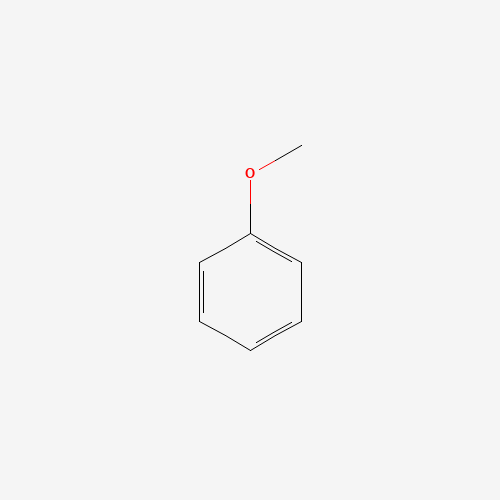
- DOT Label: Flammable Liquid
- First Aid: ERG2024, Guide 128 (Anisole): In Canada, an Emergency Response Assistance Plan (ERAP) may be required for this product. Please consult the shipping paper and/or the "ERAP" section.
- Fire Hazards: Flammable. Above 52 °C explosive vapour/air mixtures may be formed.
- Safe Storage: Fireproof.
- Fire Fighting: Use foam, powder, carbon dioxide. In case of fire: keep drums, etc., cool by spraying with water.
- Toxicity Data: LC50 (rat) > 5,000 mg/m3
- Eye Prevention: Wear safety spectacles.
- Health Hazards: ERG2024, Guide 128 (Anisole): · Runoff from fire control or dilution water may cause environmental contamination.
- Reactive Group: Ethers
- Adverse Effects: Neurotoxin - Acute solvent syndrome
- Exposure Routes: The substance can be absorbed into the body by inhalation.
- Fire Prevention: NO open flames, NO sparks and NO smoking. Above 52 °C use a closed system, ventilation and explosion-proof electrical equipment.
- Hazards Summary: Causes CNS depression in high-dose animal studies; A skin, eye, and respiratory tract irritant; [ICSC] May cause irritation; [MSDSonline]
- Inhalation Risk: No indication can be given about the rate at which a harmful concentration of this substance in the air is reached on evaporation at 20 °C.
- Skin Prevention: Protective gloves.
- Special Reports: Schultz TW et al; J Appl Toxicol 13 (6): 429-34 (1993). Predicted toxicities of aryl alkanols and related compounds /including anisole to Tetrahymena pyriformis in a population growth impairment assay/.
- DOT ID and Guide: 2222 128
- Disposal Methods: SRP: At the time of review, criteria for land treatment or burial (sanitary landfill) disposal practices are subject to significant revision. Prior to implementing land disposal of waste residue (including waste sludge), consult with environmental regulatory agencies for guidance on acceptable disposal practices.
- FDA Requirements: Anisole is a food additive permitted for direct addition to food for human consumption as a synthetic flavoring substance and adjuvant in accordance with the following conditions: 1) the quantity added to food does not exceed the amount reasonably required to accomplish its intended physical, nutritive, or other technical effect in food, and 2) when intended for use in or on food it is of appropriate food grade and is prepared and handled as a food ingredient.
- Reactivity Alerts: Peroxidizable Compound
- Spillage Disposal: Ventilation. Remove all ignition sources. Collect leaking and spilled liquid in sealable containers as far as possible. Absorb remaining liquid in sand or inert absorbent. Then store and dispose of according to local regulations.
- UN Classification: UN Hazard Class: 3; UN Pack Group: III
- Environmental Fate: ATMOSPHERIC FATE: According to a theory of gas/particle partitioning of semivolatile organic compounds in the atmosphere(2), anisole, which has a vapor pressure of 3.5 mm Hg at 25 °C(3) will exist in the ambient atmosphere as a vapor(SRC). Vapor-phase anisole is degraded in the atmosphere by reaction with photochemically-produced hydroxyl radicals(SRC); the half-life for this reaction in air is estimated to be 22 hr(1,SRC). Anisole's water solubility in water is 1520 mg/L(4), and therefore it may be washed out of the atmosphere by rain(SRC).
- First Aid Measures: Ingestion First Aid: Rinse mouth. Do NOT induce vomiting. Refer for medical attention .
- Food Survey Values: Anisole is a meat flavor volatile(1).
- Reactivity Profile: Ethers, such as ANISOLE can act as bases. They form salts with strong acids and addition complexes with Lewis acids. The complex between diethyl ether and boron trifluoride is an example. Ethers may react violently with strong oxidizing agents. In other reactions, which typically involve the breaking of the carbon-oxygen bond, ethers are relatively inert.
- Signs and Symptoms: Eye Exposure: Redness. Pain.
- Preventive Measures: Personnel protection: Avoid breathing vapors. Keep upwind. Avoid bodily contact with the material. ... Do not handle broken packages unless wearing appropriate personal protective equipment. Wash away any material which may have contacted the body with copious amounts of water or soap and water. ... If contact with the material anticipated, wear appropriate chemical protective clothing.
- Ingestion Prevention: Do not eat, drink, or smoke during work.
- Inhalation Prevention: Use ventilation, local exhaust or breathing protection.
- Nonfire Spill Response: LARGE SPILL: Dike far ahead of liquid spill for later disposal. Water spray may reduce vapor, but may not prevent ignition in closed spaces. (ERG, 2024)
- Air and Water Reactions: Flammable. Ethers tend to form unstable peroxides when exposed to oxygen. Ethyl, isobutyl, ethyl tert-butyl, and ethyl tert-pentyl ether are particularly hazardous in this respect. Ether peroxides can sometimes be observed as clear crystals deposited on containers or along the surface of the liquid. Insoluble in water
- Effluent Concentrations: In a comprehensive survey of wastewater from 4000 industrial and publicly owned treatment works (POTWs) sponsored by the Effluent Guidelines Division of the U.S. EPA, anisole was identified in discharges of the following industrial category (positive occurrences, median concn in ppb): organics and plastics (5; 64.8) and organic chemicals (30; 25.4)(1). The highest effluent concn in these industrial categories was 8660 ppb and 753 ppb, respectively(1). Anisole was found in 1 of 3 samples of trench leachate from the West Valley waste disposal site at a concn of 2.7 mg/L(2). Anisole was found in ponds holding wastes from olive oil production(3). It has also been detected in wastewater from coal gasification plants(4,5) and in one case reported to be 0.2 mg/L(4). Anisole was present in raw...
- Human Toxicity Excerpts: ... Human volunteers exposed to 200 mg/cu m /exposure time not specified/ experienced burning in the throat, irritation of the eyes and a foreign taste in the mouth.
- Fire Fighting Procedures: If material on fir or involved in fire: Do not extinguish fire unless flow can be stopped or safely confined. Use water in flooding quantities as fog. Solid streams of water may be ineffective. Cool all affected containers with flooding quantities of water. Apply water from as far a distance as possible. Use foam, dry chemical, or carbon dioxide. Keep run-off water out of sewers and water sources.
- Isolation and Evacuation: Evacuation: ERG2024, Guide 128 (Anisole): · If tank, rail tank car or highway tank is involved in a fire, ISOLATE for 800 meters (1/2 mile) in all directions; also, consider initial evacuation for 800 meters (1/2 mile) in all directions.
- Soil Adsorption/Mobility: An experimental Koc of 35 has been reported for anisole(1). Using an estimation method based on molecular connectivity indices(2), the Koc for anisole is estimated to be 118(SRC). According to a suggested classification scheme(3), these Koc values respectively suggest that anisole would be very highly mobile and highly mobile in soil and would readily leach(SRC).
- DOT Hazard Classification: Placard/Label(s)
- Natural Pollution Sources: Anisole has been found in lakes in the vicinity of Mount St Helens that received pyroclastic flow resulting from the volcanic eruption(1). It may also be formed during the combustion of hydrocarbons(2-4). This suggests that anisole may be formed naturally in the environment when hydrocarbons are burned(SRC). Since anisole has been reported as a meat flavor volatile(5), it may naturally occur in meat or be formed during cooking(SRC).
- Non-Human Toxicity Values: LD50 Rat sc 3500-4000 mg/kg /From table/
- Peroxide Forming Chemical: Reference(s): Cameo
- NFPA Hazard Classification: NFPA Instability Rating: 0 - Materials that in themselves are normally stable, even under fire conditions.
- Accidental Release Measures: Spill or Leak: ERG2024, Guide 128 (Anisole): · Water spray may reduce vapor, but may not prevent ignition in closed spaces.
- Non-Human Toxicity Excerpts: Anisole ... had an LC50 of 3021 mg/cu m /exposure time not specified/ in experiments with mice; no lethal concn could be established in rats. The cmpd was primarily an irritant and /CNS depressant/, although dystrophic changes were found in the livers of experimental animals. ...
- Artificial Pollution Sources: Anisole may be released to the environment during its manufacture, transport, disposal, and use(SRC) as an intermediate in the manufacture of organic compounds, for example fragrances and pharmaceuticals, and as a solvent and heat transfer medium(2). Anisole is formed as an impurity in the production of o-cresol and 2,6-xylenol by the alkylation of phenol with methanol(1). Anisole may be emitted from kerosine space heaters(3) and may occur in automobile exhaust(4,5).
- Environmental Biodegradation: In a 2-week biodegradation screening test (MITI test) using anisole (100 ppm) and an activated sludge inoculum, 56% of BOD was removed and at the end of the 2-week period there was an upward trend in BOD consumption(1). Anisole was readily biodegradable in another screening test; >70% DOC and >60% BOD were removed in this test(3). Anisole completely degraded in a biodegradation test that utilized a soil inoculum(2).
- Effects of Long Term Exposure: The substance defats the skin, which may cause dryness or cracking.
- Hazard Classes and Categories: Flammable agents - 2nd degree
- Effects of Short Term Exposure: The substance is irritating to the eyes, skin and respiratory tract. If this liquid is swallowed, aspiration into the lungs may result in chemical pneumonitis.
- Environmental Bioconcentration: Using its log Kow, 2.11(2), one estimates a BCF of 24 for anisole using a recommended regression equation(3). The bioconcentration of anisole in aquatic organisms was determined in a model aquatic ecosystem maintained at 26.7 °C with 12 hr of simulated daylight exposure(1). After 24 hr exposure, the ecological magnification for anisole was (organism, bioaccumulation factor): fish, 22; mosquito larva, 27; algae, 563; daphnia, 771; snails, 899(1). There were signs of considerable metabolism in all species. O-dealkylate occurred in fish and snail, hydroxylation to o- and p-methoxyphenols occurred in all species except daphnia, and conjugation occurred in alga and snails(1). According to a recommended classification scheme(4), this BCF value and its metabolism in aquatic organisms would ind...
- Volatilization from Water/Soil: The Henry's Law constant for anisole estimated to be 4.35X10⁻³ atm-cu-m/mol(SRC) using a fragment constant estimation method(1). This value indicates that anisole will volatilize rapidly from water(2,SRC). Using this value for the Henry's Law constant, the volatilization half-life from a model river (1 m deep flowing at 1 m/s with a wind speed of 3 m/s) is estimated as 3.2 hr(2,SRC). Similarly, the volatilization half-life from a model lake (1 m deep, flowing 0.05 m/sec, wind volocity of 0.5 m/sec) is estimated as 4.2 days(2,SRC). Anisole's moderate vapor pressure, 3.5 mm Hg at 25 °C(3), low adsorptivity to soil, and high Henry's Law constant(1,SRC) indicate that volatilization from dry and moist soil may occur(SRC).
- Protective Action Criteria (PAC): PAC-3: 110 [mg/m3]
- Critical Temperature and Pressure: Critical temperature: 372.4 °C; Critical pressure: 41.9 atm
- Environmental Abiotic Degradation: The rate constant for the vapor-phase reaction of anisole with photochemically produced hydroxyl radicals is estimated as 17.3X10⁻¹² cu cm/molecule-sec at 25 °C(SRC) using a molecular structure-based estimation method(1). This corresponds to an atmospheric half-life of 22 hours at an atmospheric concentration of 5X10+5 hydroxyl radicals per cu cm(SRC). Anisole is sensitive to oxidation by hydroxyl radicals in water(2). These radicals may be formed by the photolysis of nitrate radicals by sunlight. Such reactions are apt to be important in clear waters in which light can penetrate and are relatively free of humic materials and other substances that act as scavengers for hydroxyl radicals(2).
- Probable Routes of Human Exposure: NIOSH (NOES Survey 1981-1983) has statistically estimated that 469 workers are potentially exposed to anisole in the USA(1).
- Environmental Water Concentrations: SURFACE WATER: During 1982 to 1985 average anisole concns in the Rhine river ranged from 0.1 to 3 ppb(1). Monthly grab samples from the Besos and Llobregat Rivers located north and south of Barcelona, Spain ranged from <1 to 100 ng/L and <1 to 510 ng/L, respectively(2). The respective mean values (standard deviation) for these samples were 91 (180) ng/L and 34 (91) ng/L(2). The rivers flow through heavily-populated areas and receive a wide spectrum of wastes. The study was performed between March 1985 and March 1986. Anisole was also found in water samples from the Songhuajiung River basin in China(3).
- Environmental Fate/Exposure Summary: Anisole may be released to the environment during its manufacture, transport, disposal, and use as an intermediate in the manufacture of organic compounds and as a solvent and heat transfer medium. It may also be formed during the combustion of hydrocarbons and therefore may be produced both naturally and anthropogenically when hydrocarbons are burned. Anisole has a low adsorptivity to soil and if released on soil, may leach. It has a moderately high Henry's Law constant and vapor pressure and would be expected to volatilize from both moist and dry soil surfaces. Anisole is readily biodegradable in screening tests and may therefore biodegrade in soil. If released in water, anisole will be lost by volatilization. Its volatilization half-life in a model river and model lake is estimated t...
- Personal Protective Equipment (PPE): Personnel protection: ... Wear appropriate chemical protective clothing. ...
- Shipping Name/ Number DOT/UN/NA/IMO: IMO 3.3; Anisole
- Emergency Response Planning Guidelines: Emergency Response: ERG2024, Guide 128 (Anisole): · For massive fire, use unmanned master stream devices or monitor nozzles; if this is impossible, withdraw from area and let fire burn.
- Exposure Control and Personal Protection: Protective Clothing: ERG2024, Guide 128 (Anisole): · Structural firefighters' protective clothing provides thermal protection but only limited chemical protection.
Warm reminder:
Because the manufacturer may temporarily adjust product specifications, prices, inventory, parameters and other information without notice, and there are differences in each user's consultation time and procurement needs, the platform reply content is only of reference value within a certain period. Sorry for the inconvenience caused to you, and thank you for your understanding and support! Please consult the online customer service for the latest details. Everything is subject to the real-time reply of the customer service.!
Please check the quantity, appearance and product information in time when you receive the goods. In case of damage, wrong delivery, abnormal quality and other problems, please feel free to contact us.
Service Hotline:400-6226-992 ,We will handle it for you as soon as possible, thank you for your support and trust.!
Research chemical CAS 100-66-3 AR; ≥99%; 2. 5L
Research chemical CAS 100-66-3 AR; ≥99%; 2. 5L; supplied for laboratory research, analysis, inspection, and scientific procurement use; specifications: AR; ≥99%; 2. 5L.




