

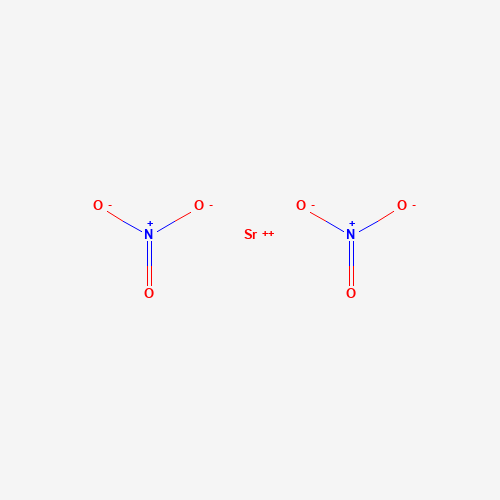
- DOT Label: Oxidizer
- First Aid: ERG2024, Guide 140 (Strontium nitrate): In Canada, an Emergency Response Assistance Plan (ERAP) may be required for this product. Please consult the shipping paper and/or the "ERAP" section.
- Treatment: Methemoglobinemia can be treated with supplemental oxygen and methylene blue 1% solution administered intravenously slowly over five minutes followed by IV flush with normal saline. Methylene blue restores the iron in hemoglobin to its normal (reduced) oxygen-carrying state. (L1613)
- Fire Hazards: ERG2024, Guide 140 (Strontium nitrate): · Runoff may create fire or explosion hazard.
- Interactions: MICE TREATED IM WITH STRONTIUM NITRATE PRIOR TO INTRAGASTRIC ADMINISTRATION OF DIMERCAPTOSUCCINIC ACID AND SODIUM BICARBONATE SHOWED AN ACCELERATED URINARY EXCRETION OF THE METAL COMPARED TO CONTROLS.
- Fire Fighting: FIRE INVOLVING TANKS, RAIL TANK CARS OR HIGHWAY TANKS: For ammonium nitrate products: Do not fight cargo fire. Withdraw, evacuate and isolate area for at least 1600 meters (1 mile). Treat as an explosive (ERG Guide 112). Do not enter area for 24 hours or until expert advice has been provided. Fight fire from maximum distance or use unmanned master stream devices or monitor nozzles. Cool containers with flooding quantities of water until well after fire is out. ALWAYS stay away from tanks in direct contact with flames. For massive fire, use unmanned master stream devices or monitor nozzles; if this is impossible, withdraw from area and let fire burn. (ERG, 2024)
- Toxicity Data: LD50: 540 mg/kg (Intraperitoneal, Rat) (T14)
- Health Effects: Nitrate and nitrite poisoning causes methemoglobinemia. Nitrites may cause pregnancy complications and developmental effects. They may also be carcinogenic. (L1137)
- Health Hazards: ERG2024, Guide 140 (Strontium nitrate): · Runoff from fire control or dilution water may cause environmental contamination.
- Reactive Group: Nitrate and Nitrite Compounds, Inorganic
- Adverse Effects: Methemoglobinemia - The presence of increased methemoglobin in the blood; the compound is classified as secondary toxic effect
- Exposure Routes: Oral (L1137); inhalation (L1137)
- Hazards Summary: A strong oxidizing agent; A fire hazard on contact with organic substances; Shock or heat may cause explosion; [Hawley] A strong skin and mild mucous membrane irritant; A strong oxidizing agent; A skin, eye, and respiratory tract irritant; [CAMEO] A skin and eye irritant; [eChemPortal: ERMA] An oxidizing agent; May cause fire on contact with combustible material; An irritant; [MSDSonline] See Strontium. See NITRATES and NITRITES.
- DOT ID and Guide: 1507 140
- Disposal Methods: SRP: At the time of review, criteria for land treatment or burial (sanitary landfill) disposal practices are subject to significant revision. Prior to implementing land disposal of waste residue (including waste sludge), consult with environmental regulatory agencies for guidance on acceptable disposal practices.
- Toxicity Summary: Nitrate's toxicity is a result of it's conversion to nitrite once in the body. Nitrite causes the autocatalytic oxidation of oxyhemoglobin to hydrogen peroxide and methemoglobin. This elevation of methemoglobin levels is a condition known as methemoglobinemia, and is characterized by tissue hypoxia, as methemoglobin cannot bind oxygen. (A2450, L1613)
- Reactivity Alerts: Strong Oxidizing Agent
- Reactivity Profile: Mixtures of metal/nonmetal nitrates with alkyl esters may explode, owing to the formation of alkyl nitrates; mixtures of a nitrate with phosphorus, tin (II) chloride, or other reducing agents may react explosively [Bretherick 1979 p. 108-109]. Special Hazards of Combustion Products: Yields toxic gaseous oxides of nitrogen when involved in fire.
- Signs and Symptoms: Nitrate and nitrite poisoning causes methemoglobinemia. Symptoms include cyanosis, cardiac dysrhythmias and circulatory failure, and progressive central nervous system (CNS) effects. CNS effects can range from mild dizziness and lethargy to coma and convulsions. (L1137)
- Preventive Measures: SRP: The scientific literature for the use of contact lenses in industry is conflicting. The benefit or detrimental effects of wearing contact lenses depend not only upon the substance, but also on factors including the form of the substance, characteristics and duration of the exposure, the uses of other eye protection equipment, and the hygiene of the lenses. However, there may be individual substances whose irritating or corrosive properties are such that the wearing of contact lenses would be harmful to the eye. In those specific cases, contact lenses should not be worn. In any event, the usual eye protection equipment should be worn even when contact lenses are in place.
- Nonfire Spill Response: LARGE SPILL: Dike far ahead of liquid spill for later disposal. (ERG, 2024)
- Air and Water Reactions: Soluble in water.
- Human Toxicity Excerpts: Acute poisoning: (From ingestion ...) Headache, flushing of skin, vomiting, dizziness, collapse, marked fall of blood pressure, cyanosis, convulsions, coma, & resp paralysis. /Nitrites & nitrates/
- Fire Fighting Procedures: If fire becomes uncontrollable - consider evacuation of one-half (1/2) mile radius.
- Isolation and Evacuation: Evacuation: ERG2024, Guide 140 (Strontium nitrate): · If ammonium nitrate products are in a tank, rail car or truck and involved in a fire, ISOLATE for 1600 meters (1 mile) in all directions; also, initiate evacuation including emergency responders for 1600 meters (1 mile) in all directions.
- Other Safety Information: Chemical Assessment: IMAP assessments - Nitric acid, strontium salt: Human health tier I assessment
- Carcinogen Classification: Ingested nitrate or nitrite under conditions that result in endogenous nitrosation is probably carcinogenic to humans (Group 2A). (L135)
- DOT Hazard Classification: Placard/Label(s)
- Non-Human Toxicity Values: LD50 Rat ip 540 mg/kg
- Accidental Release Measures: Spill or Leak: ERG2024, Guide 140 (Strontium nitrate): · Dike far ahead of liquid spill for later disposal.
- Artificial Pollution Sources: Because of its brilliant red flame, strontium (in particular, strontium nitrate) is used in pyrotechnic devices for the military (tracer ammunition, military flares, marine distress signals) as well as non-military applications including warning devices and fireworks(1). The production and use of this strontium compound may result in its release to the environment through various waste streams(SRC).
- Hazard Classes and Categories: Serious eye damage/eye irritation - Category 2B
- Explosive Limits and Potential: ... May explode when shocked or heated.
- Standard Transportation Number: 49 187 54; Strontium nitrate
- Protective Action Criteria (PAC): PAC-3: 540 [mg/m3]
- Shipment Methods and Regulations: The International Maritime Dangerous Goods Code lays down basic principles for transporting hazardous chemicals. Detailed recommendations for individual substances and a number of recommendations for good practice are included in the classes dealing with such substances. A general index of technical names has also been compiled. This index should always be consulted when attempting to locate the appropriate procedures to be used when shipping any substance or article.
- Personal Protective Equipment (PPE): Rubber gloves, goggles, laboratory coat. (USCG, 1999)
- Shipping Name/ Number DOT/UN/NA/IMO: IMO 5.1; Strontium nitrate
- Emergency Response Planning Guidelines: Emergency Response: ERG2024, Guide 140 (Strontium nitrate): · For massive fire, use unmanned master stream devices or monitor nozzles; if this is impossible, withdraw from area and let fire burn.
- Skin, Eye, and Respiratory Irritations: ... HIGHLY IRRITATING TO THE SKIN ... BUT ONLY SLIGHTLY IRRITATING TO THE MUCOSA.
- Exposure Control and Personal Protection: Protective Clothing: ERG2024, Guide 140 (Strontium nitrate): · Structural firefighters' protective clothing provides thermal protection but only limited chemical protection.
- Other Standards Regulations and Guidelines: A report from the Soviet Union ... recommended a MAC for strontium nitrate of 1 mg/cu m ... presumably as strontium, on the basis of inhalation studies in several animal species.
Warm reminder:
Because the manufacturer may temporarily adjust product specifications, prices, inventory, parameters and other information without notice, and there are differences in each user's consultation time and procurement needs, the platform reply content is only of reference value within a certain period. Sorry for the inconvenience caused to you, and thank you for your understanding and support! Please consult the online customer service for the latest details. Everything is subject to the real-time reply of the customer service.!
Please check the quantity, appearance and product information in time when you receive the goods. In case of damage, wrong delivery, abnormal quality and other problems, please feel free to contact us.
Service Hotline:400-6226-992 ,We will handle it for you as soon as possible, thank you for your support and trust.!
Research chemical CAS 10042-76-9 ≥99. 97% 500g
Research chemical CAS 10042-76-9 ≥99. 97% 500g, complete specifications; suitable for production, research, laboratory testing and inspection; digital one-stop procurement platform for scientific materials.




