

The efficacy and preparation of sodium benzoate
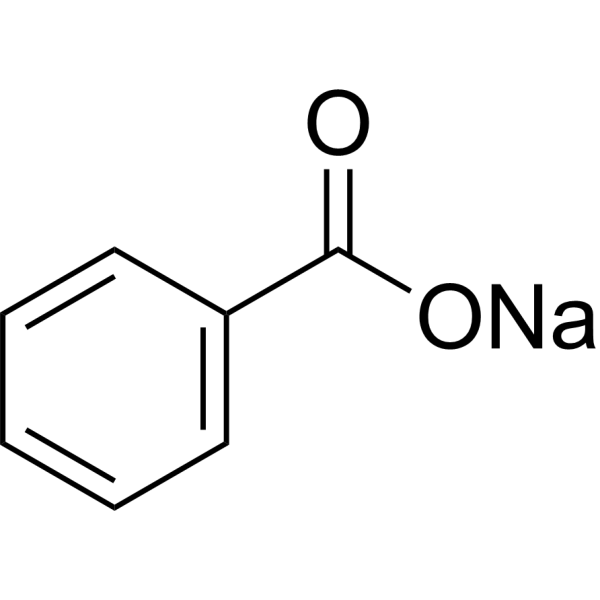
Image: Sodium benzoate structural formula
Sodium benzoate, also known as sodium benzoate, mostly white granules or crystalline powder, no odor or slightly benzoic odor, slightly sweet taste, its chemical structure formula is C7H5NaO2, is an organic matter, the relative molecular weight is 144.103, flash point (ignition point) is high, 110 degrees, so it is quite stable in air, easily soluble in water, the pH value of its aqueous solution is 7.0-8, slightly soluble in ethanol, soluble in ethanol, more physical and chemical properties and MSDS can be found in the source network.
Sodium benzoate is an acidic preservative and is often used as a broad-spectrum antimicrobial agent. It has the best antibacterial effect in an acidic environment between pH 2.5-4, but it has basically no bactericidal and antibacterial effect in alkaline media. So we can find the effective existence of sodium benzoate in fruit juices, sodas, salad dressings, and vinegar. Sodium benzoate can be produced naturally in certain foods, such as apples, pears, lingonberries, and other fruits. Some slightly sweet spices, such as cloves and cinnamon, also have a small amount of sodium benzoate.
Sodium benzoate is commonly used in food preservatives and is also often used in pharmaceuticals. However, it is mainly used for its preservative effect, mainly to prevent deterioration and acidity, thereby prolonging the shelf life. When used, it mainly works by turning into an effective form of benzoic acid. Sodium benzoate is also commonly used as a preservative in oral liquid medicines, also to prolong the shelf life. However, in the actual use process, pay attention to the amount of sodium benzoate should not be too much, otherwise the food will become very bitter. Due to the preservative and disinfectant effect of sodium benzoate, it is often used in combination with salicylic acid to treat various superficial fungal infections such as tinea corporis, tinea pallidum, and tinea pedis, or fungal infections of the skin. However, because of its corrosive nature, it needs to be guided by professionals before use. With the rapid development of sodium benzoate application research, sodium benzoate has also been widely used in other industries, including fungicides in the pharmaceutical industry, mordants in the dye industry, plasticizers in the plastics industry, and intermediates in organic synthesis such as fragrances.
Sodium benzoate has such a wide range of uses, so a lot of scientific research is carried out around sodium benzoate. In the actual research process, you can try to buy major brands of sodium benzoate reagents from Huayuan Mall, or you can try to prepare them yourself. Here are two preparation methods (see Huayuan Network for details):
1. Neutralize benzoic acid and sodium bicarbonate

(1) Add water and sodium bicarbonate to a neutralizing pot, heat to boiling, and dissolve the sodium bicarbonate in water to form a sodium bicarbonate solution.
(2) Add benzoic acid while stirring until the pH of the reaction solution is 7-7.5.
(3) Heat to cause carbon dioxide to escape from the reaction solution until it is exhausted, and add activated carbon to decolorize for 30 minutes.
(4) Suction filtration, after the filtrate is concentrated, it is slowly put into the liquid plate of the filler, dried by the drum, and pulverized to successfully obtain sodium benzoate. The ratio of sodium benzoate and sodium bicarbonate is benzoic acid (99.5%) 1045kg/t, sodium bicarbonate (98%) 610kg/t.
(5) Add 32% soda ash solution to the neutralization pot, neutralize benzoic acid to a Ph value of 7.5, and control the neutralization temperature at 70 degrees Celsius. After the neutralization liquid is decolorized with 0.3% activated carbon, it is vacuum filtered, and the filtrate is concentrated and dried, and finally becomes a powdered sodium benzoate product
2. Toluene oxidation

(1) To oxidize toluene, pump 2200kg of toluene and 2.2kg of cobalt naphthalate into an aluminum oxidation tower (700mm × 8000mm), heat it to about 120 degrees Celsius through the jacket steam, and the toluene will boil. Start a 6.0 cubic meter air compressor, and introduce compressed air into the toluene solution from the bottom of the tower through a buffer tank, and an oxidation reaction occurs...
(2) The oxidation reaction is an exothermic reaction, which will cause the reaction temperature to rise continuously. In order to control the maximum reaction temperature below 170 degrees Celsius, it is necessary to stop the heating through the jacket and switch the water cooling. A large amount of toluene vapor and water vapor generated during the oxidation reaction are discharged through the top of the tower, enter the 20-square-meter condenser, condense into a liquid, and then the liquid is introduced into the water separator. The water is discharged from the lower part of the water separator, and the toluene is returned to the oxidation tower from the upper part of the water separator and enters the metering tank. The exhaust gas passes through the exhaust gas discharge pipe on the upper cover of the water separator to the buffer tank, and then enters the activated carbon absorption tower to absorb the toluene. Timely steam is passed directly into the tower to desorb the adsorbed toluene, which is condensed, separated from water, and dried for recycling. The oxidation time of toluene at 170 degrees Celsius is about 12 to 16 hours, and the conversion rate can exceed 70%.
(3) de-benzene, to de-benzene kettle (1500L, with jacket) was introduced into the oxidation solution, heated to 100~ 110 degrees Celsius in 80 billion Pa vacuum through the jacket steam, with compressed air bubbling method of unreacted toluene evaporated into the 10 square meters of the condenser, the condensate into the water separator recycling.
(4) Distillation, the benzoic acid after benzene removal also contains impurities and organic pigments, and needs to be distilled again. The feed liquid is placed in a distillation kettle (enamel or stainless steel), heated and controlled to 190 ° C, and the benzoic acid is evaporated into the distillation column (270mm × 6000mm, with 7 trays). The temperature at the top of the tower is controlled to 160 ° C. The distillate is cooled into the neutralization kettle through the casing to obtain pure benzoic acid.
(5) Neutralization. After the benzoic acid enters the neutralization kettle, add the pre-prepared soda ash solution to neutralize in time (300L distilled water plus 140kg of soda ash can neutralize about 200kg of benzoic acid). The neutralization temperature should be 70 ° C, and the neutralization material should be at pH 7.5 as the end point. To remove variegated colors, add activated carbon to 3% of the neutralized material for decolorization, and then vacuum suction filtration to obtain a colorless and transparent sodium benzoate solution (content 50%).
(6) Drying, the sodium benzoate solution is dried by drum, or box spray drying to form a powdery finished product.




